Women have experienced the war on Gaza in deadly and brutal ways

The war on Gaza has been brutal and deadly. In just five months, an entire people has experienced unbelievable trauma and unprecedented levels of death.  But the suffering endured by women in particular in this awful and illegal war has been immense.

The statistics are horrific. Two mothers are killed every hour, 8,400 women are dead and 6,300 women have been injured in the most traumatic ways imaginable. 900,000 displaced women face starvation, and watching their children ache and die from hunger.

Daily life for women in Gaza is hellish.

This weekend if you are one of the 600,000 menstruating women in Gaza who is having a period, you won’t have access to sanitary towels or hygiene products. You will probably resort to cutting a strip from the tent you are sheltering in to help cope with the flow. Or find an old cloth or rag. This will likely give you a deadly infection.

There is no dignity in menstruating in Gaza.

And if you are one of the 180 women who give birth every day in Gaza, your new son or daughter is likely to be born on the floor of a filthy, freezing temporary shelter without medical support or care. If you are experiencing complications and are lucky enough to get to one of the last remaining functioning hospitals, there won’t be pain relief or medical supplies, even if you need a caesarean section.

Once your baby is born there will be no nappies, baby clothes to swaddle him or her in, or enough breast milk for feeding because you are malnourished.

If you are already a mother with children in Gaza, it is likely that this weekend you will be listening to their constant heartbreaking cries of hunger as starvation takes a grip in the region due to the complete destruction of food production, and the lack of food aid reaching the traumatised population. Devastatingly, the hunger crisis and looming famine has led to an increase in death among children and in cases of stillborn babies.

International Women’s Day and Mother’s Day

Over the coming days millions of women all over the world will celebrate two annual milestones, International Women’s Day and Mother’s Day. There will be lots of noise about how far women have advanced, and acknowledgement of the vital role they play in all aspects of modern life. Mothers will be rightly fussed over and spoiled, and honoured for the important job they do.

But for thousands of traumatised women and mothers in Gaza, these two days of celebration will have no meaning whatsoever as they continue to live through the daily horrors they have suffered for the last five months.

The staggering toll of violence cannot be ignored.  This violence is a stark reminder of the global failure to protect women and children in every country.

Far from flowers and lunches and warm fuzzy gatherings women in Gaza will this weekend be in a state of fear and anxiety, using whatever little human reserve they have left to simply survive.

Women and children who are hit hardest

In conflict, it is women and children who are hit hardest and who are more likely to lose their lives. 70% of the 30,000 killed so far are women and children, their homes reduced to rubble and their families torn apart. This is further exacerbated by lack of water, sanitation, health services, power and fuel supplies.

The decimation of food production and agriculture coupled with the fact hardly any food aid is getting into Gaza means the risk of death from starvation is growing by the day. Gaza is on the brink of famine. Women and their children are so hungry and desperate they are resorting to foraging for wild grasses and weeds for food.

The lack of food is already impacting on women’s health. A rise in anaemia among pregnant women has been reported at a Project HOPE clinic, where 21 percent of 416 pregnant women who visited the clinic between February 5th and 24th showed signs of malnutrition. Unless food aid distribution resumes as a matter of urgency there will be deadly and lethal consequences.

As well as the physical toll there is also a huge psychological toll on women. A psychologist working in a school shelter has shared with ActionAid staff that women and children are showing various symptoms of severe stress. They are suffering from depression, sadness, and feelings of loss. In addition, children are hyperactive, bedwetting, nail-biting and having nightmares. 

The world has failed the women of Gaza spectacularly

It is high time now that the international community and global powers – and those who proclaim to support human rights – acknowledge the abject failure to protect the most vulnerable, and to take immediate action to halt the bombardment and safeguard the lives of women and girls in Gaza.

Women have suffered in Israel too. The reports of alleged sexual violence since October 7th in both Gaza and Israel are deeply concerning. Every report of sexual violence against women demands thorough investigation. It’s not just a crime; it’s a gross violation of human rights, a war crime, and a crime against humanity under international law.

The best tribute we can make to women in Gaza and Israel this International Women’s Day is if we collectively channel our voices and influence to make a massive push to end this tragic war, and offering women  some hope of an end to the waking hell they are in.

This is the moment when world leaders need to do so much more than they have to date.

The urgency is now.  The call for an immediate and permanent ceasefire cannot wait any longer. 
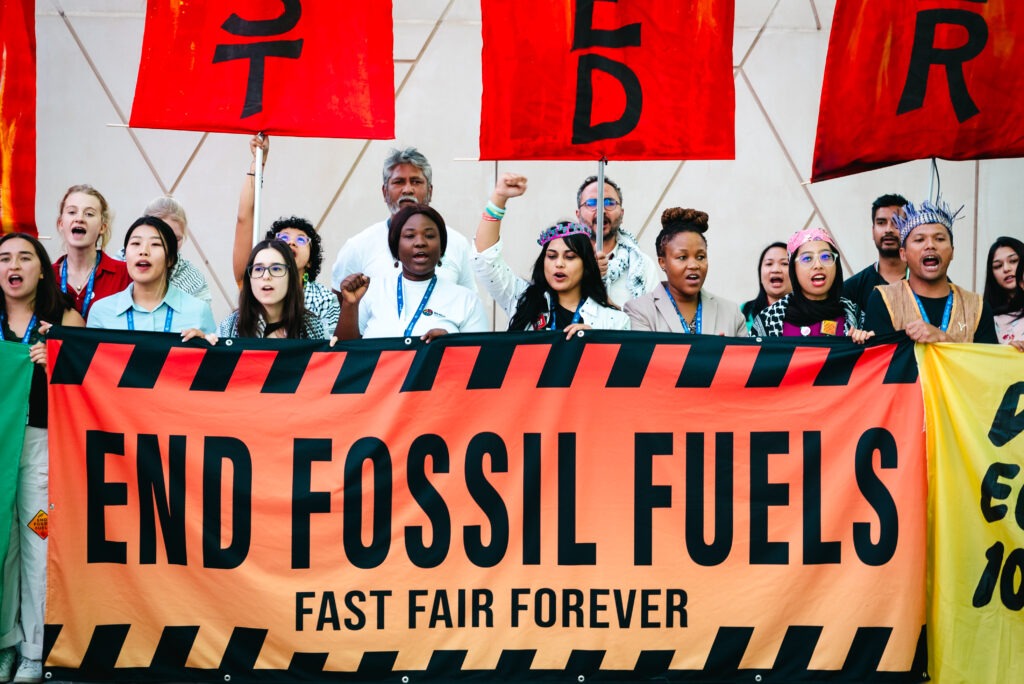
Protesters holding End Fossil Fuels banner at a climate demonstration, advocating for renewable energy solutions.

Protestors at COP 28 in Dubai. Photo: Konrad Skotnicki.

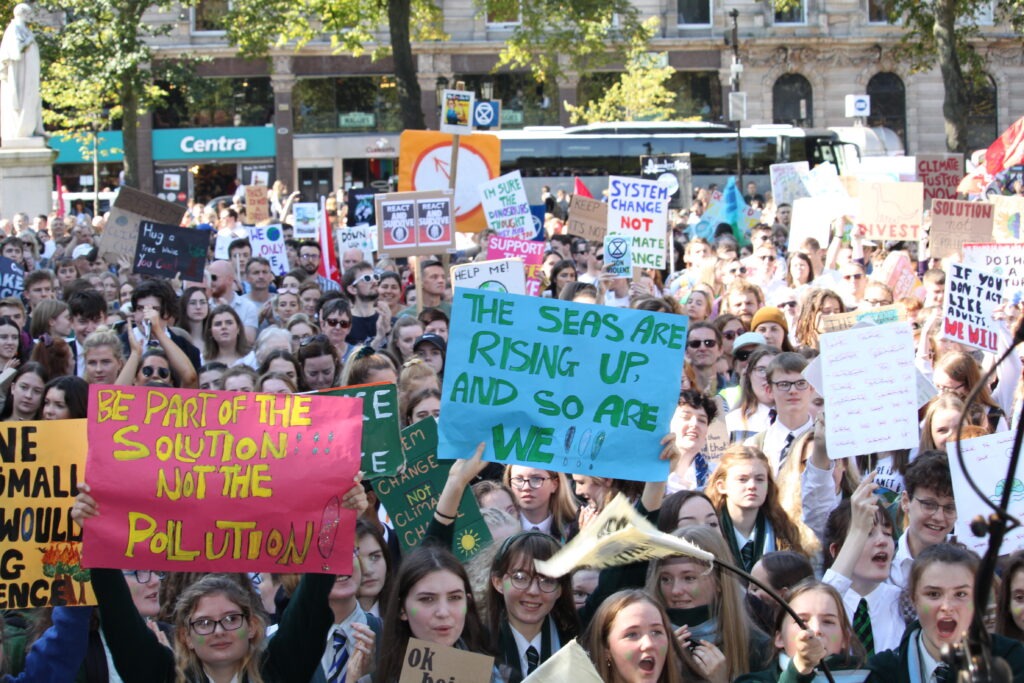
Climate protest with diverse crowd holding signs about environmental action in a city square.

Belfast Climate Change March, 2019. Photo: Trócaire.

The Profit Driving the Crisis

Despite their overwhelming contribution to global emissions, fossil fuel companies continue to attract significant financial backing—driven by their enduring profitability. This is starkly illustrated by the case of ExxonMobil, the top fossil fuel investment held by asset managers based in Ireland. In 2023, ExxonMobil reported €33.63 billion ($36 billion) in profit. That is almost twice the GDP of Botswana (€18.1 billion) and nearly three times Namibia’s GDP (€11.5 billion).

Ireland plays a hugely disproportionate role in facilitating investments into fossil fuel companies like ExxonMobil. In 2023, the investments made into fossil fuel companies by investment managers based in Ireland generated an estimated 72.5 million tons of CO2e. This is more than the CO2e emissions for the entire country of Ireland—and more than ten times that generated by Sierra Leone.

The Global Human Impact

The climate crisis is here, now, and it is causing disproportionate harm in the Global South. In Bangladesh, rising sea levels and increasingly severe cyclones are displacing coastal communities, with projections indicating that 17% of the entire country could be underwater by 2050. The legally binding Paris Agreement on climate change explicitly acknowledges the importance of tackling private finance. Its three overarching goals are: keeping below 1.5C of warming; increasing adaptation and making finance flows consistent with low emissions and resilience.

This gives a clear mandate for action:  both tax reform and corporate regulation are needed to tackle financial flows, and both nationally in Ireland and at EU level, ‘polluter pays’ taxes are lacking and regulation of the financial sector remains weak and fragmented. While EU regulation exists, it is designed more to nudge investors toward more sustainable investment practices by increasing transparency and reporting levels than to enforce strict standards. And it is moving in the wrong direction: the recently passed EU Corporate Sustainability Due Diligence Directive excluded investments; and now the EU Commission’s Omnibus legislative proposal threatens to undo the limited gains made on climate plans, as well as blocking future attempts for stronger action at national level.

The Risk of Inaction

Fossil fuel investment is too profitable to remain weakly regulated. If Ireland continues with its current strategy of encouraging FDI at all costs, and relying on weak EU regulation, we are headed for catastrophe. The Inter-governmental Panel on Climate Change has repeatedly warned that every fraction of a degree beyond 1.5°C brings irreversible consequences: collapsed ice sheets, vanishing coral reefs, and extreme weather events that will make vast regions of the planet uninhabitable. And yet, companies are developing oil and gas fields that could push global warming beyond 2°C.

Our research found that 91% of the investments made into fossil fuel companies by investment managers based in Ireland were to companies that have plans for fossil fuel expansion like these. Ireland cannot afford inaction on this issue.

About This Research

The figures in this report regarding investment from Ireland are based on new research commissioned by ActionAid Ireland and Trócaire. In the paper, we uncover the scale of fossil fuel investment through Ireland, who the investors are, and in which fossil fuel companies they are investing.  We analyse the current regulatory framework and explain why it is inadequate—and moving in the wrong direction. And we make specific recommendations for change, which are summarised below.

Summary of Recommendations

Regulate the private financial sector
Ireland must end its outsized role as an enabler of destructive fossil fuel investment. Ireland should introduce a strong gender-responsive national human rights and environmental due diligence framework which includes the regulation of investors with respect to human rights and the environment and climate. The transposition of the EU Corporate Sustainability Due Diligence Directive could achieve this if downstream activities are included and the Omnibus proposal is rejected. Ireland should prohibit investments in fossil fuel expansion and require investors to implement climate transition plans consistent with a 1.5°C climate limit.

Endorse the Fossil Fuel Non-Proliferation Treaty
Ireland should endorse developing a Fossil Fuel Non-Proliferation Treaty to curb fossil fuel expansion and commit to a fair and funded phase out of fossil fuels.

Support tax justice
Ireland should support bold and fair new global tax rules through the UN Framework Convention on Tax, should adopt all OECD BEPS measures, and should conduct an updated and comprehensive spillover analysis of its tax policy. Ireland should take coordinated action globally, at the EU level and domestically to introduce a range of new taxes to mobilise finance needed for climate justice, based on ‘polluter pays’ and social equity principles such as wealth taxes for the highest earners, climate damages tax on investors, fossil fuel production taxes and levies on aviation and shipping.

Finance a just transition
Ireland must also meet its fair share climate finance obligations under Article 9.1 of the Paris Agreement, and pay our ecological debt to the Global South. Ireland should support conditionality-free debt cancellation for countries on the front lines of the climate crisis, commit to a new UN Framework Convention on Sovereign Debt, moving debt negotiations from the IMF to the UN, and to a debt workout mechanism that is fully representative and fair.

Further reading