My name is Jessica Gill and I’m a 5th Year student in Bandon Grammar School, in West Cork. This year I travelled to Kenya with ActionAid after winning the Speech Writing Competition.
Entering the Competition
Last year I entered ActionAid’s annual Speech Writing Competition with a speech about how “furthering women’s rights is fundamental for development.”
I was then invited to give this speech at the final of the competition in the Royal Irish Academy in Dublin. Eventually, I was chosen as one of two winners of the competition
The prize was a trip funded by IrishAid to see ActionAid’s work in Kenya which I am here to speak to you about today.
Arriving in Kenya
In June, after 24 hours of travelling and a stop in Abu Dhabi, I arrived in Nairobi, Kenya. For the week that we spent in the country, I was accompanied by my teacher Ms Morley, the other winner of the competition, Sooad and her teacher Aideen.
On one of the first days in Kenya, we went to a briefing in ActionAid’s office in Nairobi, where we met with Makena, the head of programmes. She spoke about the projects we would be visiting and the work ActionAid are doing around the country. One thing she said, in particular, stuck with me. She told us that international development is like an onion, it has many complex layers. And when you peel back a layer you cry because you realise that there are many more layers underneath.
I didn’t fully understand this until I saw the projects first hand later in the week.
The projects we visited were all located in Kajiado county which is 2 hours outside of the energetic capital city. As we drove along the bumpy country roads we were astounded by the wildlife that roamed freely, spotting giraffes, gazelles, ostriches and baboons.
It was shocking to see the impact of the harsh drought. Riverbeds which were once filled with water were now completely dry. The effects of climate change has left farms desolate.
Meeting the Women’s Group
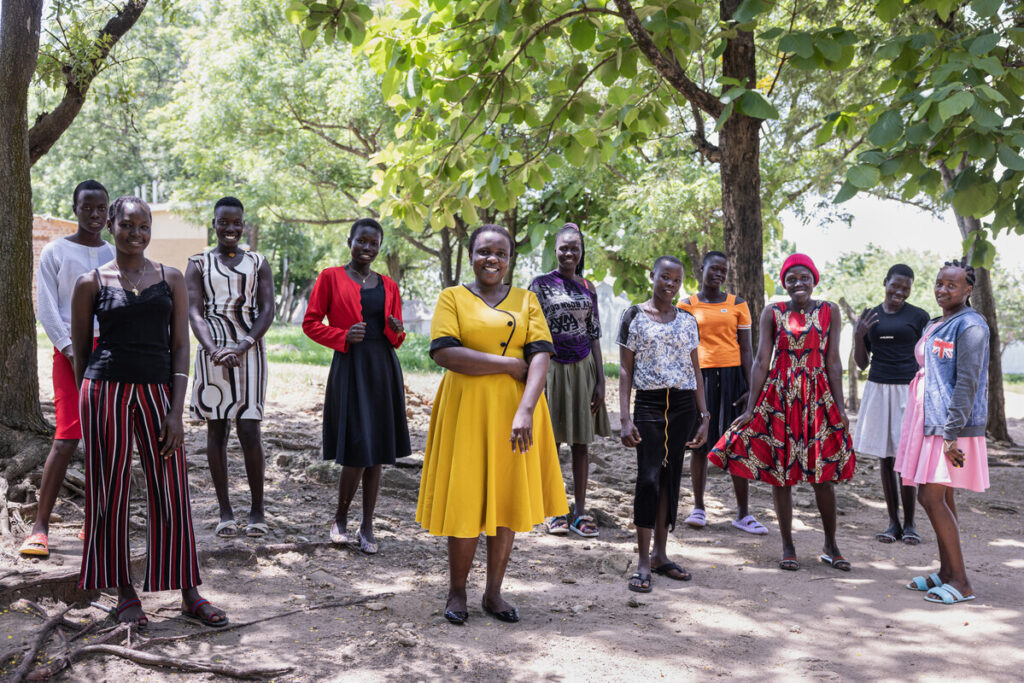
The first project we visited was the Iloodokilani women’s group, who graciously welcomed us sharing their vibrant beads and Kenyan tea. They invited us to attend one of their meetings under an acacia tree where they meet to discuss women’s rights and how they can be furthered. They described themselves as an umbrella network. Each member actively reaching out to other women in the community. And the aim is to spread education on women’s rights. ActionAid has trained the women to be efficient in the organisation of meetings and the spending of funding.
This highlights ActionAid’s key principle: Empowerment.
They don’t impose solutions but help the community to develop the skills needed to earn a living and to be agents of change.
These women have transformed the way that females are treated in the community. Before they commenced their campaign they said it was common for boys who were 12 to be called men while women of 40 were still regarded as children. Yet now, these women are figures of power in the community. In cases where a woman has been beaten by her husband or a child is being married off they seek to end the injustice and take immediate action.
The Nareto Farmer’s Group
We also met with the Nareto farmer’s group. This is a group of women who have established a milking parlour equipped with a cooler thanks to funding from ActionAid. The goal is to cooperatively run the farm in order to gain financial independence for their families. They also fund other projects that the group wish to develop.
However, four key issues challenge them: obtaining electricity to run the cooler, getting a water supply, acquiring transport to distribute the milk they produce and sourcing the funding to invest in the farm.
This really highlights the idea of the onion. As, even if the group acquire one of the things needed, if they peel back one layer of the onion, the farm cannot fully flourish without the other three necessities.
But when they do obtain these things with the help of ActionAid and those who donate to the charity, they will have a fully functioning farm that will allow them to be financially independent.
Visiting Schools
Over the week we visited 2 secondary schools, a primary school and a preschool.
The preschool children warmed our hearts with their excitement as we played with bubbles and balloons that we had brought with us. Things they had never seen before.
One of the young girls in this preschool, a girl of the age of 7, had been saved from child marriage by the Iloodokilani women’s group that I spoke about earlier. Their intervention has meant that this girl will be able to pursue her education. However, the girl’s family have rejected her as they believe that she is no longer an asset to them.
Again, this brings to mind the onion metaphor. While one layer of problems was peeled back, another became evident.
To combat this, the women’s group wish to acquire funding to build a community centre that could house girls in cases like this until further arrangements are made. This centre would also be used for meetings and training sessions for the community.
Speaking with Students
In the primary schools, we were given the opportunity to interact with the girls directly. The girls told us about the pressures that may force them to drop out of school such as migration, early marriages and responsibilities at home. The girls were also eager to learn about our culture in Ireland. They were shocked firstly, because Ireland has such a small population, secondly, when they heard that Irish women get married at 30 and thirdly, because of my age. They all thought I was too short to be 17.
These girls were only 9 and 10 years old, yet they know all about rape, female genital mutilation and early marriage. They are so young, but it is vital that ActionAid educate them about these topics so that the girls know their rights.
And it is clear that ActionAid’s work is successful because these girls do know their rights. They know that they are entitled to an education just as their brothers are and they will not let this right be taken from them.
I think one of the things about the trip that impacted me the most was seeing the dedication and the passion that these girls have for their education. They show the utmost respect for their teachers, even standing up to welcome them when they enter the room. They are eager to learn and determined to seize every opportunity given to them. Because they know that education is the most powerful weapon to change the world.
Speech Writing Competition
And I’m so grateful that I was given the opportunity to enter the Speech Writing Competition. For the opportunity to go to Kenya. And the opportunity to speak to you today because ActionAid deserves to have their phenomenal work spoken about.
They have proven that their approach to long-term development by empowerment is successful. The trip has completely shaped my perception of aid and how it should be distributed.
They make it clear that with compassion and dedication we will be able to strip back many layers of the onion. We will be able to pursue the empowerment of women. And we will be able to help these communities make real changes in their lives.
Thank you.
Pictured above are Speech Writing Competition Winners Jessica Gill and Sooad Saleh with the Iloodokilani women’s group.