New research: Local food and fuel prices more than triple in some of the world’s most at risk communities

The cost of food, fuel and fertiliser in some of the world’s poorest communities is soaring. Families are spending double, triple and in some cases nearly four times what they were paying before Russia’s invasion of Ukraine, new analysis by ActionAid finds.

The average cost of wheat products like pasta has increased by more than 50% in local markets and communities in the 13 countries surveyed. Families in Lebanon, which is heavily dependent on imports from Ukraine and Russia, are spending as much as 275% more than they were at the end of February.

In the Horn of Africa 20 million people are already facing severe hunger due to prolonged drought. Communities in Somaliland are now spending more than double (163%) as much on a loaf of bread. Average prices for cooking oil have increased by over 60%. But, in some areas of Somaliland costs are up by as much as 260%.

On Friday, the UN Food and Agriculture Organisation (FAO) released its latest global food price index, which last month found world food commodity prices reached their highest ever levels.

Download the research “Doubly Devastating” here.

Research Findings

ActionAid’s analysis finds that, at local community level, food and fuel price hikes are far outstripping already record-breaking rises globally*, suggesting the Ukraine war has exacerbated ongoing food and fuel price challenges in communities most impacted by the climate crisis, humanitarian emergencies, and political and economic turmoil. The survey of market traders and community members in 13 countries across Africa, Asia, Latin America and the Middle East, finds that the cost of essentials have increased by:

  • Fertiliser up by an average of 83% (rising by up to 196% in the Elfeta area of Ethiopia)
  • Cooking oil up by an average of 64% (rising by up to 260% in the villages of Googeysa and Xidhinta in Somaliland)
  • Petrol up by an average of 63% (rising by up to 253% in one area of Myanmar)
  • Cooking gas up by an average of 60% (rising by up to 175% in one area of Zimbabwe)
  • Pasta up by an average of 53% (rising by up to 275% in the Baalbek area of Bekaa district, Lebanon)
  • Bread up by an average of 48% (rising by up to 163% in villages of Ceel-Giniseed and Teysa, Somaliland)

Impact of Families

Mothers reported having to take their children out of school to be able to afford to buy food. And they shared their heartache at only being able to provide one meal a day for their families. In Somaliland, one woman spoke of giving her children black tea to stave off hunger pangs.

Other people said they have become sick from drinking unclean water from ponds. And many families are incurring debt to cover essential expenses such as medical costs, seeds and fertiliser.

The cost of fuel and fertilisers is also rising at an alarming rate.

ActionAid’s survey shows the cost of petrol and cooking gas has gone up by around 60% on average. However, one community in Myanmar reports that the cost of petrol has soared by 253%. Families in Zimbabwe report petrol increases as high as 227% and cooking gas increases up by 175%.

Chemical fertilisers, a key component of industrialised farming systems, require large amounts of fossil fuels for their production. The survey shows that the average price of fertiliser has already increased by more than 80%. However, in one district of Ethiopia prices have gone up by as much as 196%. Planting season is about to begin or already underway in many parts of the world. Crop yields and farming incomes are set to be hit hard in 2022. 

Teresa Anderson, ActionAid International’s global climate justice lead, says:

“The conflict in Ukraine has created a perfect storm of skyrocketing prices for food, fuel and fertiliser, disproportionately affecting local communities who barely have any belt left to tighten.

“Our survey found that in some places, prices are now double, triple or almost four times as much compared to before the war started.

“The world is now on track for a global food crisis that looks set to be far more deadly, devastating and prolonged than that of 2007-08. Governments and international institutions must take urgent action to avert catastrophic hunger on an unprecedented scale.”

Joy Mabenge, Country Director of ActionAid Zimbabwe, says:

“The price increases since the start of the Ukraine war are further eroding living standards and are severely affecting the poorest and most marginalised.”

Many of the countries where the survey was carried out, rely heavily on imported goods, making them hugely susceptible to changes in global markets.

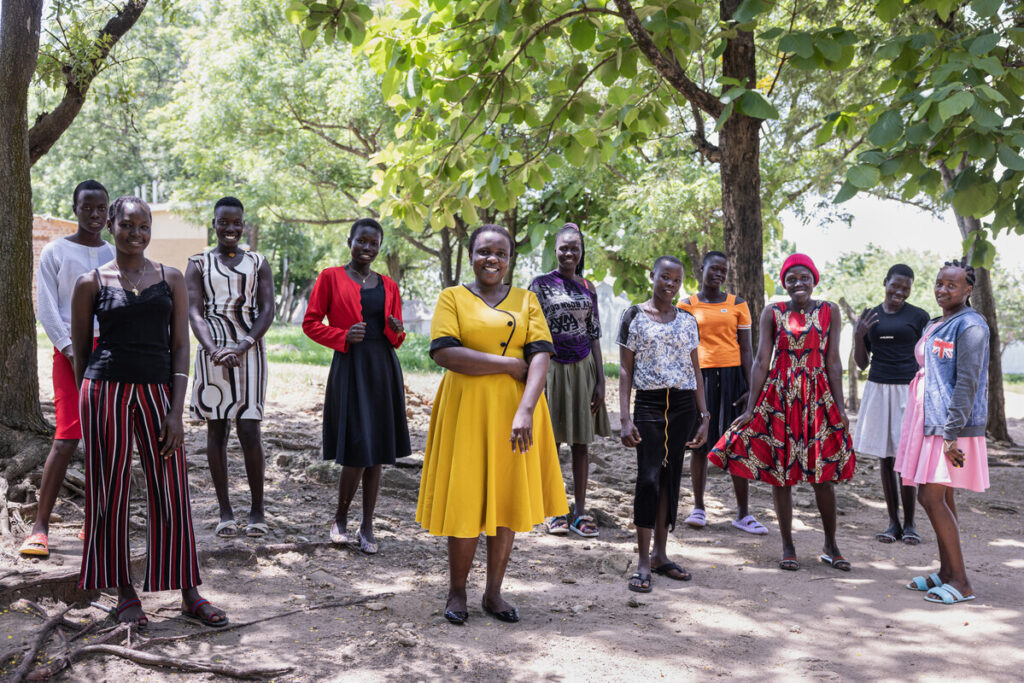
In Somaliland, Maryan Muhumed Hudhun, (pictured below, photo credit ActionAid), a smallholder farmer and mother of six, told ActionAid:

“We don’t produce anything in Somaliland. Whatever food we consume here is made outside, such as rice, pasta or oil.

“Whatever impacts the world will impact us as well. I am worried about not being able to get water, or food even.”

Call for agroecology

ActionAid is calling for the immediate roll out of social protection measures, which target women and girls. These should include cash transfers, food support and free school meals, to assist families most at risk.

To avert dramatic global yield losses later this year from a worldwide lack of fertilisers, governments must rapidly train farmers on agroecological approaches. Agroecology means adopting farming practices that work with nature. This should include using local manure to build soil fertility and reduce reliance on chemical fertilisers.

In the longer term, governments dependent on food imports must also invest in national and regional food reserves. As a result, this will act as buffers and reduce countries’ vulnerability to food shortages and price rises. The global fallout from the Ukraine crisis shows why a just transition to renewable energy and agroecological farming practices is more urgent than ever. We need to address climate change and protect communities from shocks to world food and energy markets. 
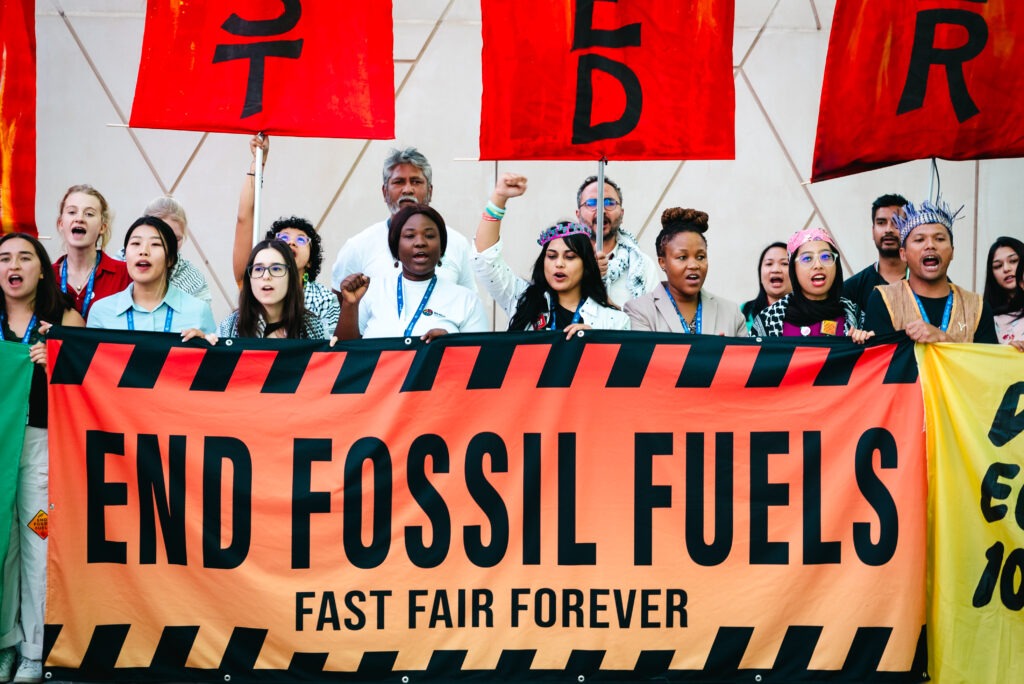
Protesters holding End Fossil Fuels banner at a climate demonstration, advocating for renewable energy solutions.

Protestors at COP 28 in Dubai. Photo: Konrad Skotnicki.

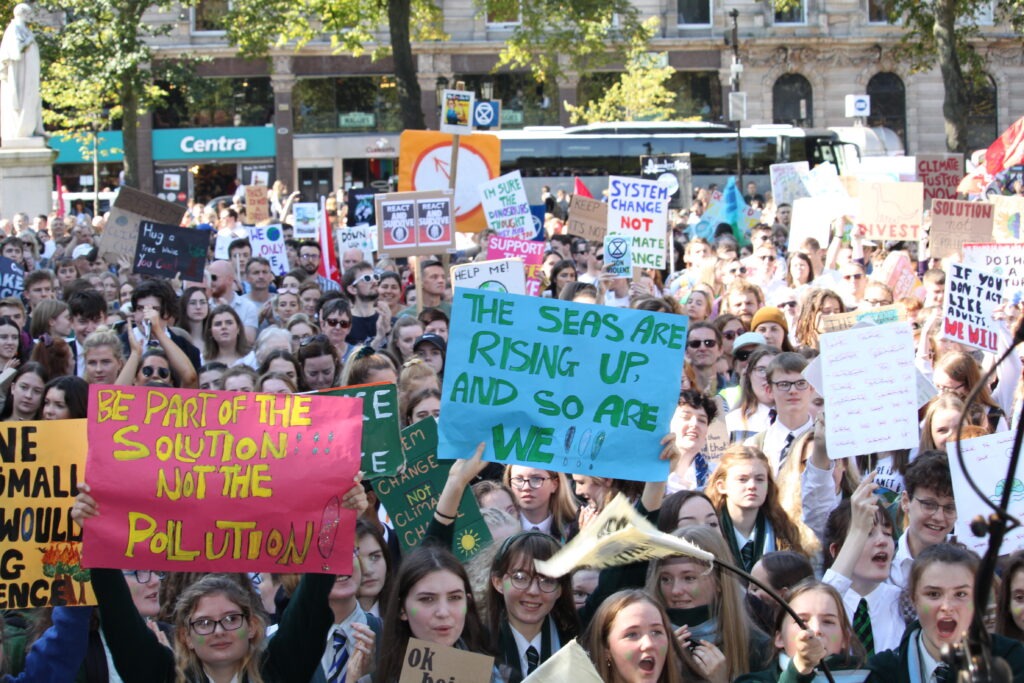
Climate protest with diverse crowd holding signs about environmental action in a city square.

Belfast Climate Change March, 2019. Photo: Trócaire.

The Profit Driving the Crisis

Despite their overwhelming contribution to global emissions, fossil fuel companies continue to attract significant financial backing—driven by their enduring profitability. This is starkly illustrated by the case of ExxonMobil, the top fossil fuel investment held by asset managers based in Ireland. In 2023, ExxonMobil reported €33.63 billion ($36 billion) in profit. That is almost twice the GDP of Botswana (€18.1 billion) and nearly three times Namibia’s GDP (€11.5 billion).

Ireland plays a hugely disproportionate role in facilitating investments into fossil fuel companies like ExxonMobil. In 2023, the investments made into fossil fuel companies by investment managers based in Ireland generated an estimated 72.5 million tons of CO2e. This is more than the CO2e emissions for the entire country of Ireland—and more than ten times that generated by Sierra Leone.

The Global Human Impact

The climate crisis is here, now, and it is causing disproportionate harm in the Global South. In Bangladesh, rising sea levels and increasingly severe cyclones are displacing coastal communities, with projections indicating that 17% of the entire country could be underwater by 2050. The legally binding Paris Agreement on climate change explicitly acknowledges the importance of tackling private finance. Its three overarching goals are: keeping below 1.5C of warming; increasing adaptation and making finance flows consistent with low emissions and resilience.

This gives a clear mandate for action:  both tax reform and corporate regulation are needed to tackle financial flows, and both nationally in Ireland and at EU level, ‘polluter pays’ taxes are lacking and regulation of the financial sector remains weak and fragmented. While EU regulation exists, it is designed more to nudge investors toward more sustainable investment practices by increasing transparency and reporting levels than to enforce strict standards. And it is moving in the wrong direction: the recently passed EU Corporate Sustainability Due Diligence Directive excluded investments; and now the EU Commission’s Omnibus legislative proposal threatens to undo the limited gains made on climate plans, as well as blocking future attempts for stronger action at national level.

The Risk of Inaction

Fossil fuel investment is too profitable to remain weakly regulated. If Ireland continues with its current strategy of encouraging FDI at all costs, and relying on weak EU regulation, we are headed for catastrophe. The Inter-governmental Panel on Climate Change has repeatedly warned that every fraction of a degree beyond 1.5°C brings irreversible consequences: collapsed ice sheets, vanishing coral reefs, and extreme weather events that will make vast regions of the planet uninhabitable. And yet, companies are developing oil and gas fields that could push global warming beyond 2°C.

Our research found that 91% of the investments made into fossil fuel companies by investment managers based in Ireland were to companies that have plans for fossil fuel expansion like these. Ireland cannot afford inaction on this issue.

About This Research

The figures in this report regarding investment from Ireland are based on new research commissioned by ActionAid Ireland and Trócaire. In the paper, we uncover the scale of fossil fuel investment through Ireland, who the investors are, and in which fossil fuel companies they are investing.  We analyse the current regulatory framework and explain why it is inadequate—and moving in the wrong direction. And we make specific recommendations for change, which are summarised below.

Summary of Recommendations

Regulate the private financial sector
Ireland must end its outsized role as an enabler of destructive fossil fuel investment. Ireland should introduce a strong gender-responsive national human rights and environmental due diligence framework which includes the regulation of investors with respect to human rights and the environment and climate. The transposition of the EU Corporate Sustainability Due Diligence Directive could achieve this if downstream activities are included and the Omnibus proposal is rejected. Ireland should prohibit investments in fossil fuel expansion and require investors to implement climate transition plans consistent with a 1.5°C climate limit.

Endorse the Fossil Fuel Non-Proliferation Treaty
Ireland should endorse developing a Fossil Fuel Non-Proliferation Treaty to curb fossil fuel expansion and commit to a fair and funded phase out of fossil fuels.

Support tax justice
Ireland should support bold and fair new global tax rules through the UN Framework Convention on Tax, should adopt all OECD BEPS measures, and should conduct an updated and comprehensive spillover analysis of its tax policy. Ireland should take coordinated action globally, at the EU level and domestically to introduce a range of new taxes to mobilise finance needed for climate justice, based on ‘polluter pays’ and social equity principles such as wealth taxes for the highest earners, climate damages tax on investors, fossil fuel production taxes and levies on aviation and shipping.

Finance a just transition
Ireland must also meet its fair share climate finance obligations under Article 9.1 of the Paris Agreement, and pay our ecological debt to the Global South. Ireland should support conditionality-free debt cancellation for countries on the front lines of the climate crisis, commit to a new UN Framework Convention on Sovereign Debt, moving debt negotiations from the IMF to the UN, and to a debt workout mechanism that is fully representative and fair.

Further reading