New report from ActionAid and Oxfam: International community must prevent further actions by Israel to forcibly displace Palestinians

A new report highlights how six months of Israel’s devastating military assault on the Gaza Strip has precipitated a catastrophic humanitarian crisis and the forced displacement of nearly two million Palestinians within the besieged enclave.

Read the report “Compelled to Flee” here.

The report from ActionAid and Oxfam, titled “Compelled to Flee”, says while Palestinians have experienced a long history of mass forced displacement, the current onslaught in Gaza is unprecedented in terms of violence and levels of displacement, raising clear concerns that serious violations of international humanitarian law and atrocity crimes are being committed on a vast scale.

The report also highlights and expresses concern over Israeli plans to expel Palestinians en masse from Gaza.

Karol Balfe, CEO of ActionAid Ireland, said:

“Israel’s devastating military assault on the Gaza Strip – deemed by the International Court of Justice to constitute a risk of genocide – is completely unprecedented. Over 75% of the population has been displaced, many multiple times. Israel has orchestrated the destruction of Gaza’s civilian infrastructure, including essential services and facilities. Together with the imposition of severe restrictions on the delivery of humanitarian aid, it has rendered Gaza unliveable.”

Ms Balfe continued: “Israel has also taken actions that exacerbate the effects of forced displacement – many of which also amount to war crimes, including attacking civilians, launching indiscriminate attacks, starvation and collective punishment. This is a human made and entirely avoidable crisis. The international community must move immediately to bring it to an end.”

“Israel has a history of dispossessing Palestinians. The failure to hold Israel to account for decades of Palestinian dispossession has created an environment in which Israel acts with increasing impunity. Nations bear legal and moral obligations to protect civilians, prevent atrocity crimes and uphold international law.”

Oxfam Ireland CEO, Jim Clarken, said,

The horror of a planned ground offence on Rafah looms large. Governments must actively prevent any action by the Israeli government that could extend or legitimise forced displacement of Palestinians within the occupied territories, including any ‘evacuation plans’.”

He added: “Israel has been clear about its plans to clear Gaza and thankfully world leaders have rejected this. This must be followed with further measures – particularly to address forcible transfer, which is likely to have already occurred inside both Gaza and the West Bank, including East Jerusalem. The US, for instance, has not demonstrated any inclination to shift from a policy of unconditional military support for Israel, even when its apparent ‘red lines’ are crossed.”

If Israel will not change course, then the international community must use every tool it has to demonstrate to Israel that its illegal actions will not be tolerated. If the people of Gaza do not die from the bombings, they could die from hunger. We need an immediate and lasting ceasefire and the opening up of all border crossings allowing in life-saving aid.”

Forcible Transfer

The report said the displacement in Gaza is likely to constitute “forcible transfer” which is a grave breach of international humanitarian law, and which is defined as both a war crime and a crime against humanity under the Rome Statute of the International Criminal Court.

The report also says since 7 October there has also been a dramatic increase in settlement building and in the severity and regularity of Israeli settler violence against Palestinians in the West Bank, accelerating displacement.

UN figures show that between 7 October and the beginning of March there were 603 settler attacks against Palestinians in the West Bank resulting in casualties and property damages with 1,240 Palestinians from 19 herding communities displaced as a direct result of settler violence.

The report calls for:

  • A full, immediate and unconditional ceasefire and the withdrawal of all Israeli forces from the Gaza Strip.
  • Any actions or policies by the Israeli government that could legitimise or lead to the ongoing or extended forced displacement of Palestinian residents to be opposed.
  • All possible steps to be taken to ensure that all displaced Palestinians within Gaza and the West Bank are permitted to safely return to their usual place of residence as soon as hostilities in those areas cease.
  • Ensure that all essential aid, including water, food, medicine and fuel be allowed into Gaza immediately to meet the needs of the civilian population, including the specific needs of women, children, elderly people and people with disabilities.
  • Demand that Israel complies with international law by ending the military occupation of the Occupied Palestinian Territory and the 16-year closure and blockade of Gaza.
  • Ensure the full participation of Palestinian women’s and young people’s organisations in humanitarian funding decision-making processes and
  • Prompt, thorough and effective investigations by qualified and independent bodies, including judicial and non-judicial accountability mechanisms, of all alleged violations of international law in the context of the Occupied Palestinian Territory.  

Read the full report here.

Pictured: camps for internally displaced people in the south of Gaza. Photo by ActionAid
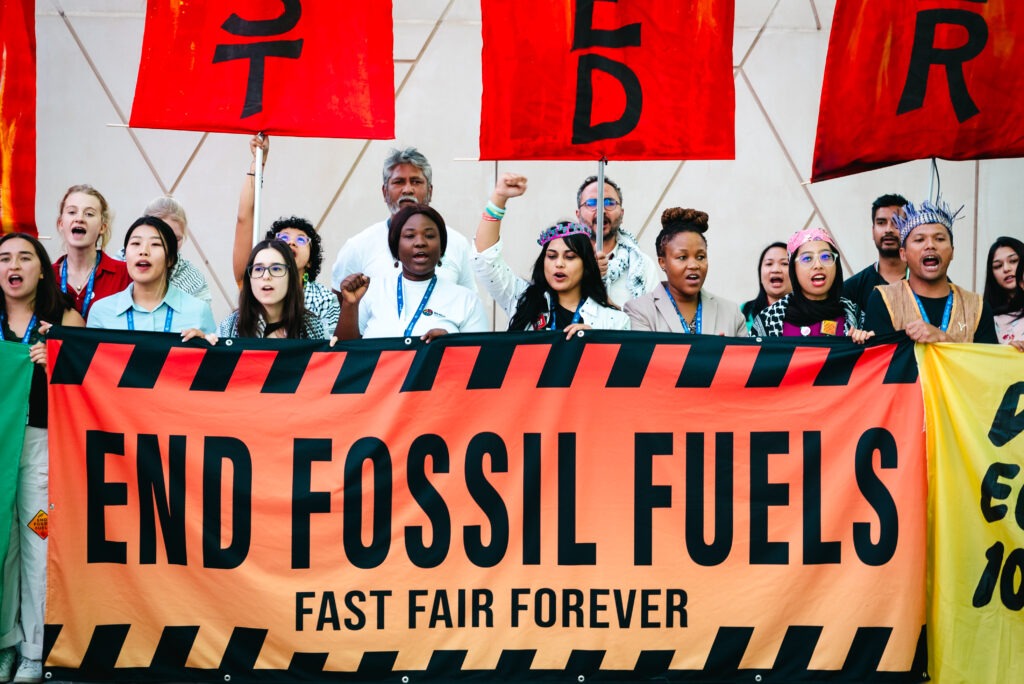
Protesters holding End Fossil Fuels banner at a climate demonstration, advocating for renewable energy solutions.

Protestors at COP 28 in Dubai. Photo: Konrad Skotnicki.

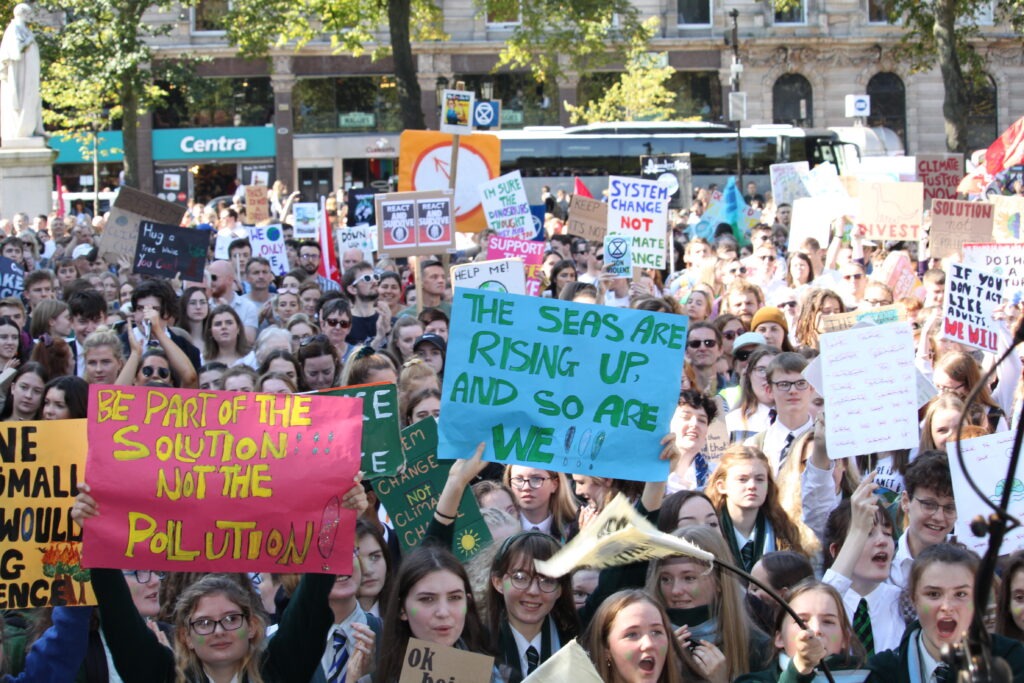
Climate protest with diverse crowd holding signs about environmental action in a city square.

Belfast Climate Change March, 2019. Photo: Trócaire.

The Profit Driving the Crisis

Despite their overwhelming contribution to global emissions, fossil fuel companies continue to attract significant financial backing—driven by their enduring profitability. This is starkly illustrated by the case of ExxonMobil, the top fossil fuel investment held by asset managers based in Ireland. In 2023, ExxonMobil reported €33.63 billion ($36 billion) in profit. That is almost twice the GDP of Botswana (€18.1 billion) and nearly three times Namibia’s GDP (€11.5 billion).

Ireland plays a hugely disproportionate role in facilitating investments into fossil fuel companies like ExxonMobil. In 2023, the investments made into fossil fuel companies by investment managers based in Ireland generated an estimated 72.5 million tons of CO2e. This is more than the CO2e emissions for the entire country of Ireland—and more than ten times that generated by Sierra Leone.

The Global Human Impact

The climate crisis is here, now, and it is causing disproportionate harm in the Global South. In Bangladesh, rising sea levels and increasingly severe cyclones are displacing coastal communities, with projections indicating that 17% of the entire country could be underwater by 2050. The legally binding Paris Agreement on climate change explicitly acknowledges the importance of tackling private finance. Its three overarching goals are: keeping below 1.5C of warming; increasing adaptation and making finance flows consistent with low emissions and resilience.

This gives a clear mandate for action:  both tax reform and corporate regulation are needed to tackle financial flows, and both nationally in Ireland and at EU level, ‘polluter pays’ taxes are lacking and regulation of the financial sector remains weak and fragmented. While EU regulation exists, it is designed more to nudge investors toward more sustainable investment practices by increasing transparency and reporting levels than to enforce strict standards. And it is moving in the wrong direction: the recently passed EU Corporate Sustainability Due Diligence Directive excluded investments; and now the EU Commission’s Omnibus legislative proposal threatens to undo the limited gains made on climate plans, as well as blocking future attempts for stronger action at national level.

The Risk of Inaction

Fossil fuel investment is too profitable to remain weakly regulated. If Ireland continues with its current strategy of encouraging FDI at all costs, and relying on weak EU regulation, we are headed for catastrophe. The Inter-governmental Panel on Climate Change has repeatedly warned that every fraction of a degree beyond 1.5°C brings irreversible consequences: collapsed ice sheets, vanishing coral reefs, and extreme weather events that will make vast regions of the planet uninhabitable. And yet, companies are developing oil and gas fields that could push global warming beyond 2°C.

Our research found that 91% of the investments made into fossil fuel companies by investment managers based in Ireland were to companies that have plans for fossil fuel expansion like these. Ireland cannot afford inaction on this issue.

About This Research

The figures in this report regarding investment from Ireland are based on new research commissioned by ActionAid Ireland and Trócaire. In the paper, we uncover the scale of fossil fuel investment through Ireland, who the investors are, and in which fossil fuel companies they are investing.  We analyse the current regulatory framework and explain why it is inadequate—and moving in the wrong direction. And we make specific recommendations for change, which are summarised below.

Summary of Recommendations

Regulate the private financial sector
Ireland must end its outsized role as an enabler of destructive fossil fuel investment. Ireland should introduce a strong gender-responsive national human rights and environmental due diligence framework which includes the regulation of investors with respect to human rights and the environment and climate. The transposition of the EU Corporate Sustainability Due Diligence Directive could achieve this if downstream activities are included and the Omnibus proposal is rejected. Ireland should prohibit investments in fossil fuel expansion and require investors to implement climate transition plans consistent with a 1.5°C climate limit.

Endorse the Fossil Fuel Non-Proliferation Treaty
Ireland should endorse developing a Fossil Fuel Non-Proliferation Treaty to curb fossil fuel expansion and commit to a fair and funded phase out of fossil fuels.

Support tax justice
Ireland should support bold and fair new global tax rules through the UN Framework Convention on Tax, should adopt all OECD BEPS measures, and should conduct an updated and comprehensive spillover analysis of its tax policy. Ireland should take coordinated action globally, at the EU level and domestically to introduce a range of new taxes to mobilise finance needed for climate justice, based on ‘polluter pays’ and social equity principles such as wealth taxes for the highest earners, climate damages tax on investors, fossil fuel production taxes and levies on aviation and shipping.

Finance a just transition
Ireland must also meet its fair share climate finance obligations under Article 9.1 of the Paris Agreement, and pay our ecological debt to the Global South. Ireland should support conditionality-free debt cancellation for countries on the front lines of the climate crisis, commit to a new UN Framework Convention on Sovereign Debt, moving debt negotiations from the IMF to the UN, and to a debt workout mechanism that is fully representative and fair.

Further reading