The sultry heat, with temperatures as high as 31C, welcomes you to Parsa. The district is about 30 minutes by flight from Kathmandu. Here we use our behaviour change approach to look at the three factors that interact to create a behaviour. These are capability to carry out the behaviour, opportunity to practise the behaviour and what motivates one to practise it.
Our behaviour change approach considers capability, opportunity and motivation
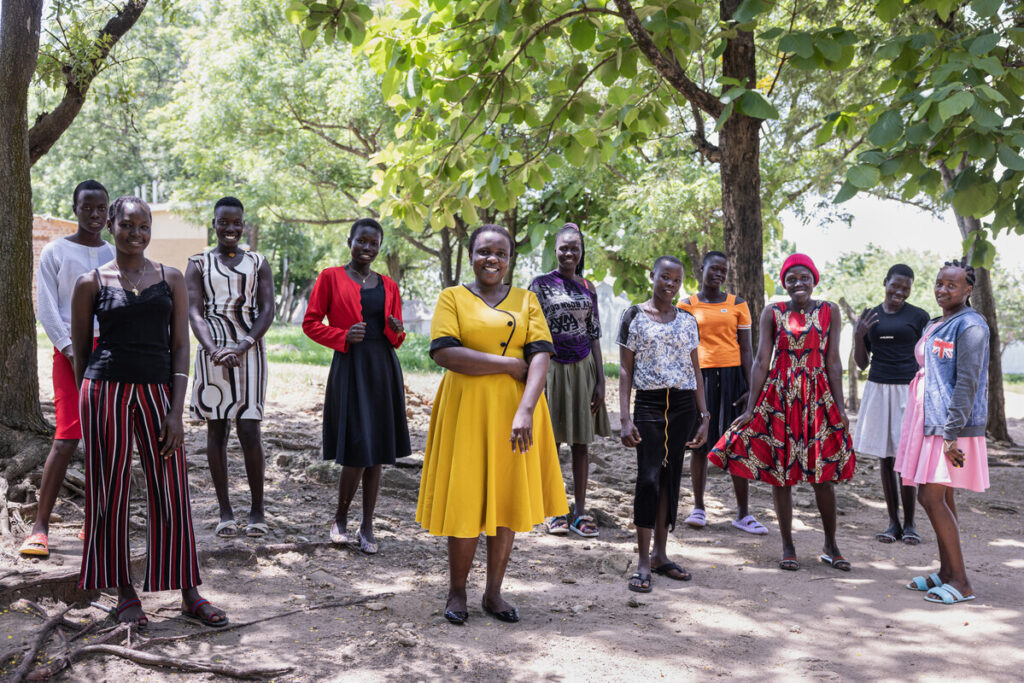
Our first stop is a women’s group working on issues around child marriage in Pokhariya, Makwanpur.
On our way, colleagues from the Divya Youth Club, the ActionAid Nepal partner working with the women, joins us. At the venue, we find the women’s group patiently seated waiting for us. After the pleasantries, which include having a thick red ochre plastered on my forehead, we sit down with the women. I can barely wait for the discussions to start, to save me from the struggle of introducing myself in Nepali.
We discuss the problem of child marriage at large – the causes, effects and dowry culture that reinforces it. Mostly, discussions focus on the financial implications of the dowry system. In particular, they talk about the pressure on even the poorest families to give a dowry. Given that we work with the most marginalised in the community, it is understandable that finance tops the cause list.
I begin to feel light headed as the heat overwhelms me. And I can’t help but pray silently that I don’t faint. Also I notice that I am the only one sweating profusely, as my body try to adjust to the high humidity. Someone hands me a paper towel to stop me from drowning in my own sweat.
Despite this, I still gather from the discussions how the dowry system reinforces the practice of child marriage in Nepal. Given it’s an old age practice, to realise any tangible results we’ll have to break it down piece by piece. Starting with working with the boys’ and girls’ parents.
We resolve to begin by changing the behaviours of those involved in the initial stage of the child marriage process. That is the girls’ parents who often set out to seek suitors, the boys’ parents, then the boys and girls.
We work with many in society as part of our behaviour change approach
Before the day ends, it is time to meet the girls’ and the boys’ group. Our behaviour change approach requires us to constantly engage the community in conversation. We need to gain a deeper understanding of the drivers and influencers of the actions we target to change.
They share with us that they’ve been at the forefront of challenging child marriage. They share that loading household chores on girls is a big driver of the practice. This means less time to focus on school and they end up dropping out due to poor performance in class. Parents are afraid that the girls will elope with the boys and run away from home. This drives the parents to seek suitors for them before that occurs.
All is not lost though. As I take a stock of the day, it seems to end with a promise. A promise of a better future for Nepali girls. There’s already one example we can see. One of the social mobilisers working in the project is a lady defying the odds. She avoided marrying young and is pursuing her education – she is currently doing her Masters. We can only hope that she becomes a role model and inspires a generation of other young ladies and parents.
The next day, we are on the road. For an environmental enthusiast, the green canopies and rivers flowing along the road to Makwanpur are a breath-taking sight! The road looks narrow as it’s shared by pedestrians, motorcyclists, lorries and passenger vehicles with no clear-cut boundaries between users. Two hours and 30 minutes later, we are in Makwanpur.
Increased economic security for women through our behaviour change approach
Here we meet another group of women we are working with to improve their economic security. We drive slightly out of town to meet the women, passing through a cement factory. It appears to be derelict land, yet that’s not the case. Someone tells me it’s one of the two largest cement factories in the area.
As is often the case, we find a few women already seated, waiting for us. Someone tells me it’s a festival day and the women must travel back to their homes to celebrate. The focus for this women’s group is income generation through farming.
They share that previously they were content with the little they produced in their farms for themselves. They never ventured into using farming to earn extra income. However, the work with ActionAid has seen things change. The women now go the extra mile to produce more and sell. Before they didn’t know that they could earn money from farming, now they do.
This has led to less domestic violence cases. The women now share the household responsibilities with their husbands, relieving the pressure on men to be the only providers. This has in turn led to the men forming their own group of 13 members.
Our behaviour change approach involves addressing men’s behaviours
Next, we walk for a few minutes, just a stone’s throw away, and find a group of men. Most are under 20, dotted with a few middle-aged men and just a tiny number I would consider elderly. I can see from their beaming faces that they clearly appreciate the impact the programme has had on their lives.
They formed their own group to actively engage in economic activities, because they wanted to benefit the same way the women’s group have. To realise these benefits, and sustain the change, they have set rules and regulations to guide the group. For example, they impose a fine on members who engage in domestic violence. Further, they counsel members engaged in alcoholism and gambling and save on a monthly basis.
This example shows how our behaviour change approach in practice helps to improve women’s rights. Read about the behaviour change approach we use in our Women’s Rights Programme here.
Photo caption: Erick Onduru, Program Learning Coordinator, with Nisha Karki, Women’s Rights Coodinator and Behaviour Change Champion, pictured in Nepal. Photo by ActionAid.