Celebrating women-responders this International Women’s Day

This International Women’s Day, we are celebrating the women responding on the frontlines of emergencies and humanitarian crises.  

Women are hit hardest in times of crisis and by climate change. When a family faces hunger, it is women who eat least and last. When a government cuts back on public funding, it is often the services that serve women more than men that are cut first. Women end up carrying a double care burden when this happens. 

In humanitarian crises, ActionAid promotes women’s leadership and rights. We ensure women are empowered to make decisions about the needs of their community. We know that women bring vital skills, resources, and experience to humanitarian response. And when crises happen, they are often the first responders, taking risks and playing critical roles in the survival of families and communities. 

International Women’s Day 2023

This International Women’s Day, we want to say a collective #THANKYOU to all the women-responders who have played a vital role in recent, and historic, crises and emergencies. 

Women at the frontlines of our earthquake response in Syria 

Following the devastating earthquake in Turkey and Syria last month, women and girls were among those hardest hit. Their circumstances are becoming increasingly alarming.  

The protection of women and girls is a priority for ActionAid. Our local partner Violet is providing safe spaces for women and girls to shelter, mental health support for shock and trauma and care for pregnant women.  

Hala is a 23-year-old law student who works with Violet, ActionAid’s partner in Northwest Syria. She is currently working in a safe space that Violet set up for women and children affected by the earthquake that struck Turkey and Syria in February. At the safe space they offer kid’s activities and mental health support for women. They also hold awareness sessions around the prevention of sexual abuse and exploitation, legal rights and life skills for women and girls. She told us: ‘Even if the situation is bad, it’s my duty to offer help to people. Because after 12 years of war, it’s our duty to help each other, in all difficult circumstances.’ 

Hala, Syria.

Women responding to the climate crisis 

East Africa is facing its worst food crisis in decades. The food crisis has been caused by multiple factors including the escalating effects of climate change with back-to-back droughts and locust plagues, the Covid-19 pandemic and protracted conflict. 

During climate disasters, women and girls are disproportionately affected by hunger, displacement, debt, and certain types of violence.  

Women are also at the heart of the response to the food crisis.  

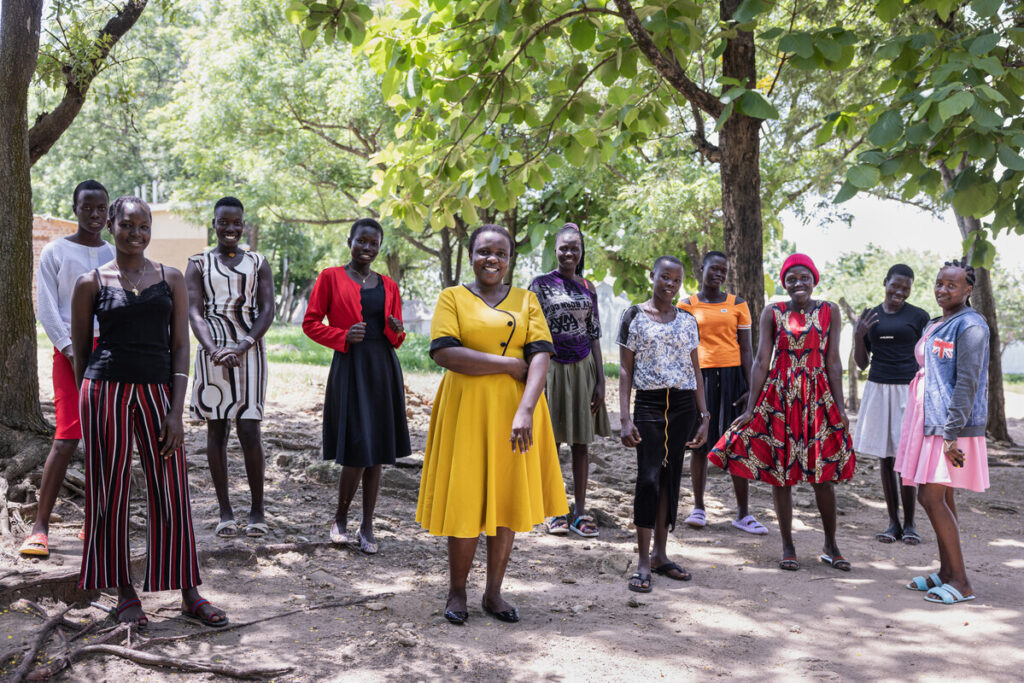
Hibo is a Community Empowerment and Engagement Officer at ActionAid International Somaliland, an autonomous region in Somalia. She is passionate about women’s rights and is a trained human rights lawyer. She said: “Generally, women in Somaliland have a lot of responsibilities in life. That’s why they feel a lot of impact.” Women like Hibo work with communities to ensure all our response puts the safety and wellbeing of women and girls first. Hibo leads training sessions and immerses herself in the communities; gaining trust and respect.  

Hibo, Somaliland.

Women in Ukraine 

A year on from the invasion of Ukraine, women and girls affected are experiencing escalating threats of sexual and gender-based violence as the conflict continues. We have supported over 1,000,000 people in Ukraine, Poland, Moldova, and Romania, working with 28 local partners.  

One of ActionAid’s partner organisations, Girls, provides a safe space for survivors of gender-based violence. They offer psychosocial support for girls and women affected by the conflict in Ukraine.  

Yuliya Sporysh, founder of NGO Girls says ‘‘Having experienced the horrors of war, women and girls deserve care and protection. Women and their kids can heal and regain their independence in a secure environment like ours. While many of Ukraine’s war-affected women have survived acts of violence caused by the war, many of the women we work with have managed to escape domestic abuse.” 

We are continuing to expand to meet this growing need. Here Jara Henar, ActionAid’s migration and asylum expert, describes how we are expanding our work on the border of Ukraine and Moldova.  

Find out more about how you can support ActionAid to respond to emergencies.
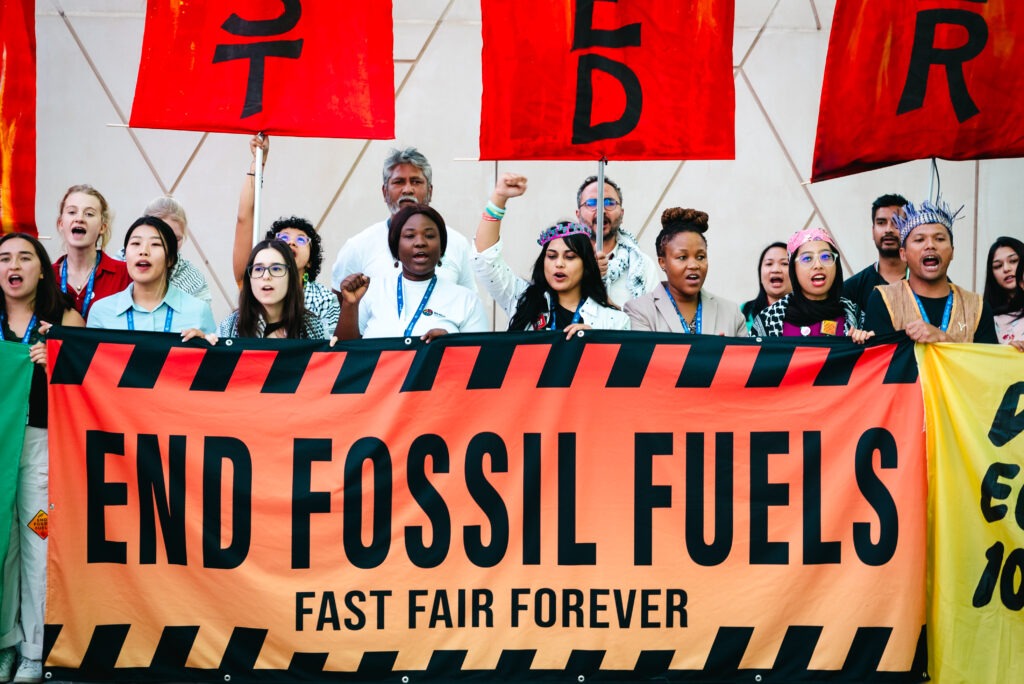
Protesters holding End Fossil Fuels banner at a climate demonstration, advocating for renewable energy solutions.

Protestors at COP 28 in Dubai. Photo: Konrad Skotnicki.

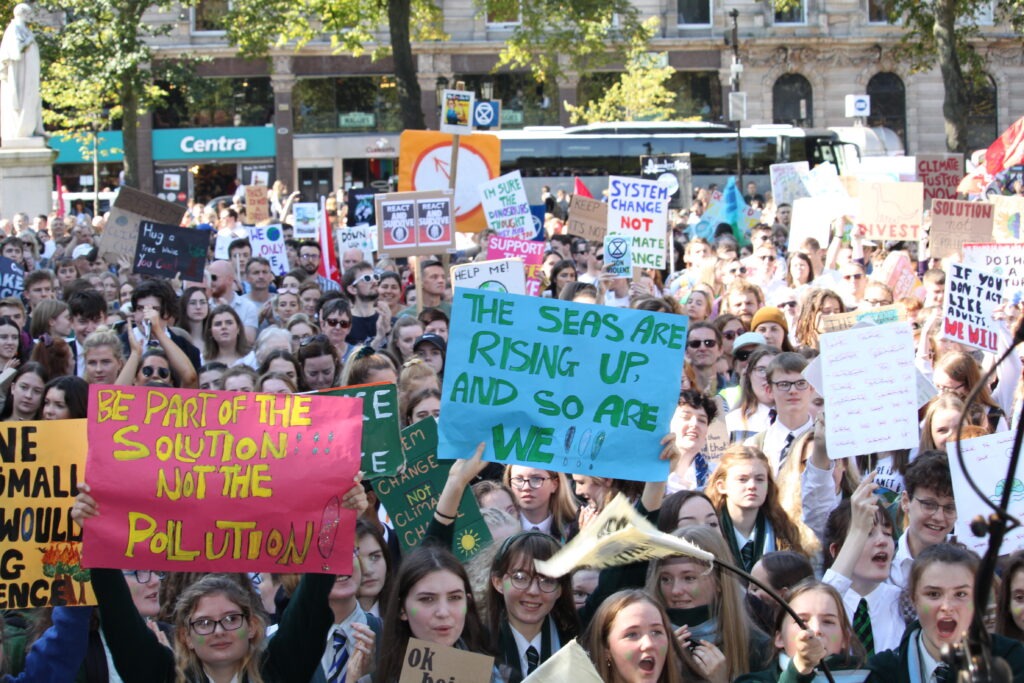
Climate protest with diverse crowd holding signs about environmental action in a city square.

Belfast Climate Change March, 2019. Photo: Trócaire.

The Profit Driving the Crisis

Despite their overwhelming contribution to global emissions, fossil fuel companies continue to attract significant financial backing—driven by their enduring profitability. This is starkly illustrated by the case of ExxonMobil, the top fossil fuel investment held by asset managers based in Ireland. In 2023, ExxonMobil reported €33.63 billion ($36 billion) in profit. That is almost twice the GDP of Botswana (€18.1 billion) and nearly three times Namibia’s GDP (€11.5 billion).

Ireland plays a hugely disproportionate role in facilitating investments into fossil fuel companies like ExxonMobil. In 2023, the investments made into fossil fuel companies by investment managers based in Ireland generated an estimated 72.5 million tons of CO2e. This is more than the CO2e emissions for the entire country of Ireland—and more than ten times that generated by Sierra Leone.

The Global Human Impact

The climate crisis is here, now, and it is causing disproportionate harm in the Global South. In Bangladesh, rising sea levels and increasingly severe cyclones are displacing coastal communities, with projections indicating that 17% of the entire country could be underwater by 2050. The legally binding Paris Agreement on climate change explicitly acknowledges the importance of tackling private finance. Its three overarching goals are: keeping below 1.5C of warming; increasing adaptation and making finance flows consistent with low emissions and resilience.

This gives a clear mandate for action:  both tax reform and corporate regulation are needed to tackle financial flows, and both nationally in Ireland and at EU level, ‘polluter pays’ taxes are lacking and regulation of the financial sector remains weak and fragmented. While EU regulation exists, it is designed more to nudge investors toward more sustainable investment practices by increasing transparency and reporting levels than to enforce strict standards. And it is moving in the wrong direction: the recently passed EU Corporate Sustainability Due Diligence Directive excluded investments; and now the EU Commission’s Omnibus legislative proposal threatens to undo the limited gains made on climate plans, as well as blocking future attempts for stronger action at national level.

The Risk of Inaction

Fossil fuel investment is too profitable to remain weakly regulated. If Ireland continues with its current strategy of encouraging FDI at all costs, and relying on weak EU regulation, we are headed for catastrophe. The Inter-governmental Panel on Climate Change has repeatedly warned that every fraction of a degree beyond 1.5°C brings irreversible consequences: collapsed ice sheets, vanishing coral reefs, and extreme weather events that will make vast regions of the planet uninhabitable. And yet, companies are developing oil and gas fields that could push global warming beyond 2°C.

Our research found that 91% of the investments made into fossil fuel companies by investment managers based in Ireland were to companies that have plans for fossil fuel expansion like these. Ireland cannot afford inaction on this issue.

About This Research

The figures in this report regarding investment from Ireland are based on new research commissioned by ActionAid Ireland and Trócaire. In the paper, we uncover the scale of fossil fuel investment through Ireland, who the investors are, and in which fossil fuel companies they are investing.  We analyse the current regulatory framework and explain why it is inadequate—and moving in the wrong direction. And we make specific recommendations for change, which are summarised below.

Summary of Recommendations

Regulate the private financial sector
Ireland must end its outsized role as an enabler of destructive fossil fuel investment. Ireland should introduce a strong gender-responsive national human rights and environmental due diligence framework which includes the regulation of investors with respect to human rights and the environment and climate. The transposition of the EU Corporate Sustainability Due Diligence Directive could achieve this if downstream activities are included and the Omnibus proposal is rejected. Ireland should prohibit investments in fossil fuel expansion and require investors to implement climate transition plans consistent with a 1.5°C climate limit.

Endorse the Fossil Fuel Non-Proliferation Treaty
Ireland should endorse developing a Fossil Fuel Non-Proliferation Treaty to curb fossil fuel expansion and commit to a fair and funded phase out of fossil fuels.

Support tax justice
Ireland should support bold and fair new global tax rules through the UN Framework Convention on Tax, should adopt all OECD BEPS measures, and should conduct an updated and comprehensive spillover analysis of its tax policy. Ireland should take coordinated action globally, at the EU level and domestically to introduce a range of new taxes to mobilise finance needed for climate justice, based on ‘polluter pays’ and social equity principles such as wealth taxes for the highest earners, climate damages tax on investors, fossil fuel production taxes and levies on aviation and shipping.

Finance a just transition
Ireland must also meet its fair share climate finance obligations under Article 9.1 of the Paris Agreement, and pay our ecological debt to the Global South. Ireland should support conditionality-free debt cancellation for countries on the front lines of the climate crisis, commit to a new UN Framework Convention on Sovereign Debt, moving debt negotiations from the IMF to the UN, and to a debt workout mechanism that is fully representative and fair.

Further reading