The best response when the world as we know it is in deep crisis? My answer – join together, work together on our common goals.

Blog by ActionAid Ireland, CEO, Siobhan McGee, originally posted on the Dochas website: https://www.dochas.ie/blog/best-response-when-world-we-know-it-deep-crisis-my-answer-join-together-work-together-our Dochas is the Irish Association of NGOs.

Recently, on 22 September 2020, after years in the planning, six NGOs* launched a new alliance – the Irish Emergency Alliance – specially formed to fundraise jointly in response to humanitarian disasters. Many of us are familiar with the Disasters Emergency Committee (DEC) in the UK, and there are eight similar entities mostly in OECD countries, with advanced plans to launch alliances in France, USA and Australia.

As one of the founding CEOs, I was kindly asked by Dóchas to write about the formation of the Alliance.

There are at least two parts to the story – the commitment of six CEOs to the notion of collaboration, of doing more to mobilise public support for humanitarian disasters, to get more coverage for the impact of (in this case) the dreadful coronavirus pandemic which is wreaking havoc on the global south – and pushing back against a growing trend towards very nationalistic, very local coverage, away from international coverage.

In practical terms it took nearly three years to get to launch (the February 2020 election followed swiftly by the pandemic thwarted plans to launch earlier in 2020). Working on this since late 2017, we could never have foreseen a global pandemic emerging which would call for us to act together, but it did, and we have.

Before that, we started out as six CEOs to hone a shared vision for the project, learning from countries where such alliances are up and running. We got great insights from them and from the Emergency Appeals Alliance (EEA). We decided to press forward, and research we undertook told us that 77% of people in Ireland who will donate to a humanitarian disaster response said they would rather do so through an alliance than to an individual agency.

Buoyed by that, we committed to create the organisational model for Ireland, mapping the details of how the co-operation would work across our teams, thrashing out details on shared costs and income, developing governance and other policies. We registered with the Charities Regulator and the Companies Registration Office, and in 2018 established a formal Board with three independent members alongside the six CEO members.

By early 2019, we were ready to talk to potential media partners, and to other NGOS who might consider joining. Naturally, that took time. As an unproven entity, it was a big ask of media partners, but the venture was assisted by the fact that RTE’s Head of NEWS, Jon Williams, was very familiar with and enthusiastic about the concept from his time at the BBC, where he worked with the Disasters Emergency Committee (DEC). He ‘got’ the concept immediately, but even so, these are big decisions for media organsiations, and there were various rounds of discussions before the RTE commitment was confirmed. Other media partners – NewsTalk, Virgin Media and DMG, likewise had their own decision-making processes to complete.

We also spent time meeting with several NGOs who considered joining. While they eventually chose not to join the Alliance at that time, we remain open to that and firmly want the Alliance to grow.

So, in 2020 with a global pandemic rampaging across the world, affecting the poorest countries on the planet, and with all our planning done, we knew we had to launch – if not for a global pandemic, then, when?

Public reaction has been fantastic. People really appreciate the co-operation. They also know, notwithstanding how challenging this pandemic is for all of us living here in Ireland, that there are people whose very lives are threatened by the pandemic. The Alliance is up and running and receiving donations minute by minute. Through media appearances we got the chance to convey the impact of the pandemic – stories that are not being told enough.

Some of the conversations I’ve had as a result are humbling and inspiring. I never fail to be amazed by the deep generosity and sense of connection Irish people have with those less fortunate. One woman I spoke with last week reflected on doing her family genealogy and remarked on what our forefathers and mothers had to endure, and interestingly – on how and when we received help from others. This was what influenced her decision to support.

What else? Personally, as a former fundraiser, I see this Alliance as a disrupter. Putting it simply, up to now Irish NGOs do not have a track record of co-operating on fundraising.

Our supporters really don’t understand why that is, especially when it comes to humanitarian appeals. They see us wasting resources when our objectives are so similar. I agree with that. I believe it is time to rethink how we communicate with supporters, how we as NGOs use the space we occupy and make the most of it, so we can continue to build solidarity between Irish and people in far flung parts of the world who need that external support.

Most people do not close themselves off to care only about those in their own circle. They care about other people in distress, even when they don’t know them personally. Let’s continue to offer that bridge between people and keep Ireland as a people and country open to the wider world.

*Members of the Irish Emergency Alliance are ActionAid, Christian Aid, Plan International, Self Help Africa, TearFund and World Vision.
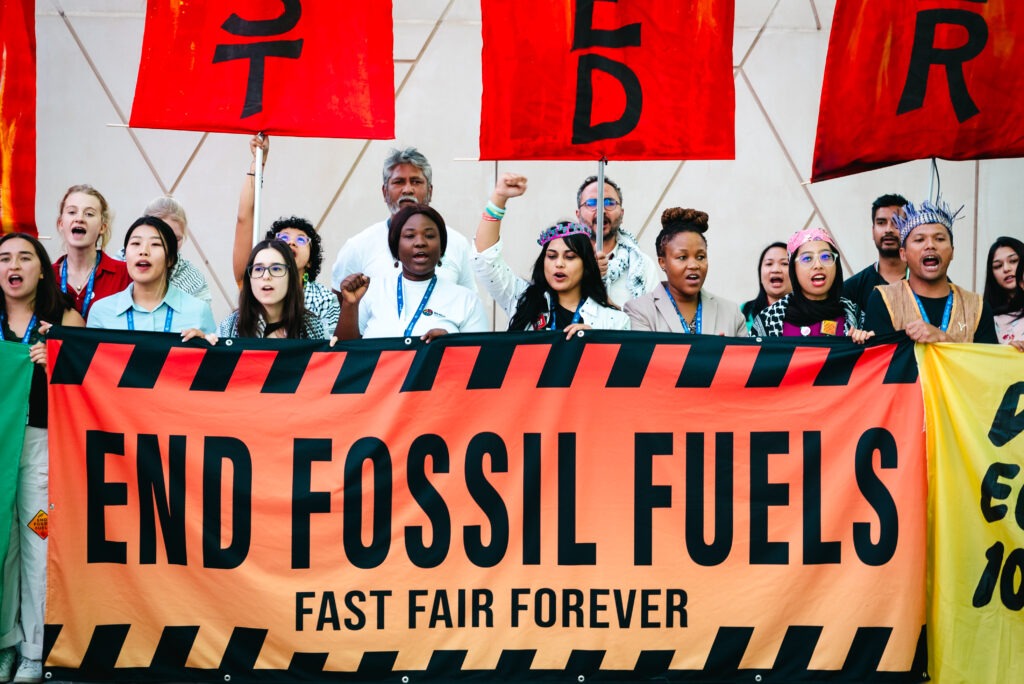
Protesters holding End Fossil Fuels banner at a climate demonstration, advocating for renewable energy solutions.

Protestors at COP 28 in Dubai. Photo: Konrad Skotnicki.

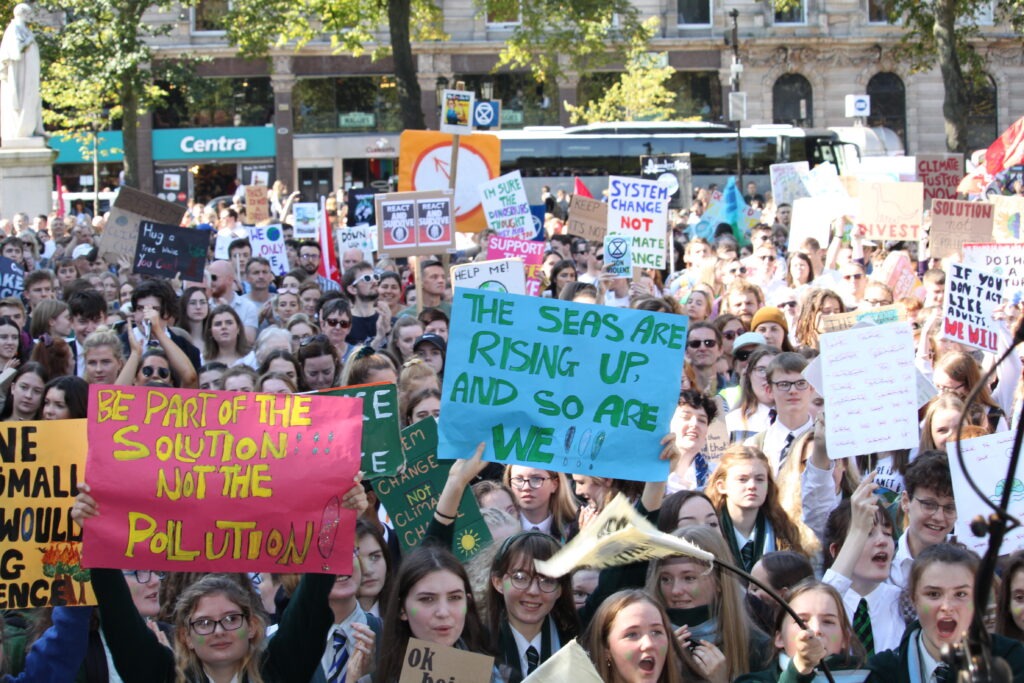
Climate protest with diverse crowd holding signs about environmental action in a city square.

Belfast Climate Change March, 2019. Photo: Trócaire.

The Profit Driving the Crisis

Despite their overwhelming contribution to global emissions, fossil fuel companies continue to attract significant financial backing—driven by their enduring profitability. This is starkly illustrated by the case of ExxonMobil, the top fossil fuel investment held by asset managers based in Ireland. In 2023, ExxonMobil reported €33.63 billion ($36 billion) in profit. That is almost twice the GDP of Botswana (€18.1 billion) and nearly three times Namibia’s GDP (€11.5 billion).

Ireland plays a hugely disproportionate role in facilitating investments into fossil fuel companies like ExxonMobil. In 2023, the investments made into fossil fuel companies by investment managers based in Ireland generated an estimated 72.5 million tons of CO2e. This is more than the CO2e emissions for the entire country of Ireland—and more than ten times that generated by Sierra Leone.

The Global Human Impact

The climate crisis is here, now, and it is causing disproportionate harm in the Global South. In Bangladesh, rising sea levels and increasingly severe cyclones are displacing coastal communities, with projections indicating that 17% of the entire country could be underwater by 2050. The legally binding Paris Agreement on climate change explicitly acknowledges the importance of tackling private finance. Its three overarching goals are: keeping below 1.5C of warming; increasing adaptation and making finance flows consistent with low emissions and resilience.

This gives a clear mandate for action:  both tax reform and corporate regulation are needed to tackle financial flows, and both nationally in Ireland and at EU level, ‘polluter pays’ taxes are lacking and regulation of the financial sector remains weak and fragmented. While EU regulation exists, it is designed more to nudge investors toward more sustainable investment practices by increasing transparency and reporting levels than to enforce strict standards. And it is moving in the wrong direction: the recently passed EU Corporate Sustainability Due Diligence Directive excluded investments; and now the EU Commission’s Omnibus legislative proposal threatens to undo the limited gains made on climate plans, as well as blocking future attempts for stronger action at national level.

The Risk of Inaction

Fossil fuel investment is too profitable to remain weakly regulated. If Ireland continues with its current strategy of encouraging FDI at all costs, and relying on weak EU regulation, we are headed for catastrophe. The Inter-governmental Panel on Climate Change has repeatedly warned that every fraction of a degree beyond 1.5°C brings irreversible consequences: collapsed ice sheets, vanishing coral reefs, and extreme weather events that will make vast regions of the planet uninhabitable. And yet, companies are developing oil and gas fields that could push global warming beyond 2°C.

Our research found that 91% of the investments made into fossil fuel companies by investment managers based in Ireland were to companies that have plans for fossil fuel expansion like these. Ireland cannot afford inaction on this issue.

About This Research

The figures in this report regarding investment from Ireland are based on new research commissioned by ActionAid Ireland and Trócaire. In the paper, we uncover the scale of fossil fuel investment through Ireland, who the investors are, and in which fossil fuel companies they are investing.  We analyse the current regulatory framework and explain why it is inadequate—and moving in the wrong direction. And we make specific recommendations for change, which are summarised below.

Summary of Recommendations

Regulate the private financial sector
Ireland must end its outsized role as an enabler of destructive fossil fuel investment. Ireland should introduce a strong gender-responsive national human rights and environmental due diligence framework which includes the regulation of investors with respect to human rights and the environment and climate. The transposition of the EU Corporate Sustainability Due Diligence Directive could achieve this if downstream activities are included and the Omnibus proposal is rejected. Ireland should prohibit investments in fossil fuel expansion and require investors to implement climate transition plans consistent with a 1.5°C climate limit.

Endorse the Fossil Fuel Non-Proliferation Treaty
Ireland should endorse developing a Fossil Fuel Non-Proliferation Treaty to curb fossil fuel expansion and commit to a fair and funded phase out of fossil fuels.

Support tax justice
Ireland should support bold and fair new global tax rules through the UN Framework Convention on Tax, should adopt all OECD BEPS measures, and should conduct an updated and comprehensive spillover analysis of its tax policy. Ireland should take coordinated action globally, at the EU level and domestically to introduce a range of new taxes to mobilise finance needed for climate justice, based on ‘polluter pays’ and social equity principles such as wealth taxes for the highest earners, climate damages tax on investors, fossil fuel production taxes and levies on aviation and shipping.

Finance a just transition
Ireland must also meet its fair share climate finance obligations under Article 9.1 of the Paris Agreement, and pay our ecological debt to the Global South. Ireland should support conditionality-free debt cancellation for countries on the front lines of the climate crisis, commit to a new UN Framework Convention on Sovereign Debt, moving debt negotiations from the IMF to the UN, and to a debt workout mechanism that is fully representative and fair.

Further reading