On Friday the Irish public go to the polls to elect the next government. How people will decide who to vote for can range from what your local TD has done for the community, who your loved ones vote for, how vocal they are on issues that matter to you or, what they stand for, or it could simply come down to your gut when you arrive at the polling station.
Crucially important is what the political parties have committed to in their manifestos. The main political parties in Ireland have now all released their manifestos which set out their promises on a range of issues their parties will commit to if elected. Some parties are writing them as they expect they will be in government and hence will need to deliver on what they set out. Other parties are writing them from the perspective of possibly being in opposition.
Our engagement on the manifestos
Over the past six months ActionAid Ireland wrote to all parties seeking engagement on our key asks in their manifestos (read ActionAid Irelands manifesto for gender transformative change here).
We stressed to each party that if they wanted to address the complex challenges facing the world today, they need to ensure transformative change for women’s rights. We highlighted four ways we believe the parties could ensure a more just, caring and sustainable world, where women live free from violence, poverty and marginalisation. They were:
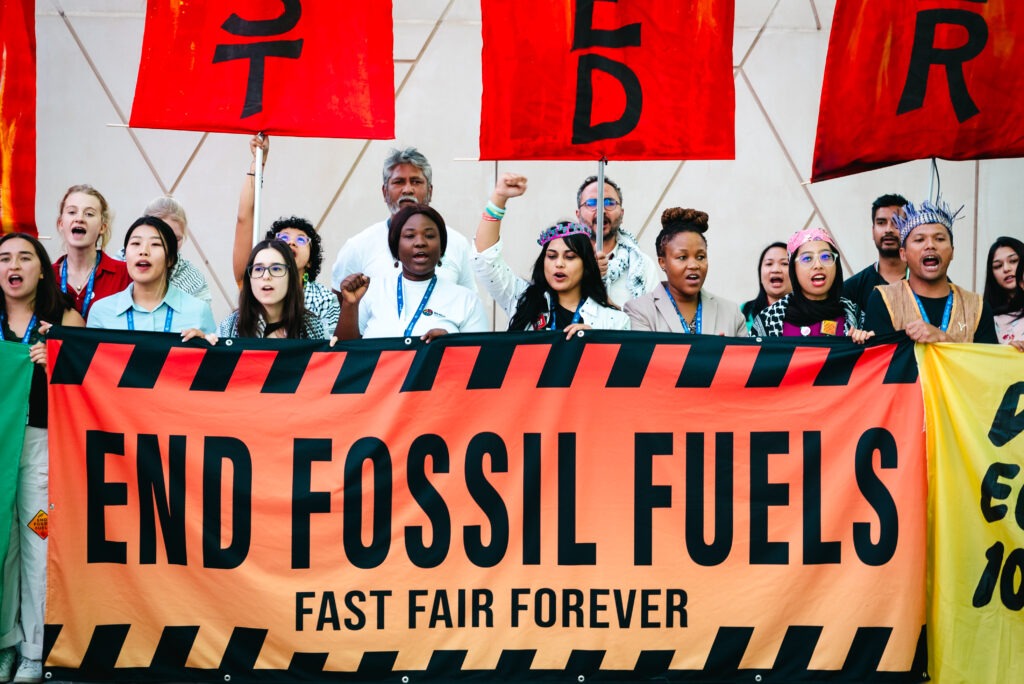
- Climate action that transforms women’s lives: Recognizing the historical responsibility of a country like Ireland and the need to phase and out fossil fuels in a way that is fair, fully financed and enables a just and feminist transition.
- Fulfilling our international obligation in a way that delivers for women: Recognizing and delivering on Ireland’s international obligations, ensuring that they deliver for women’s rights and gender equality.
- Maintain focus and pressure on the Occupied Palestinian Territory.
- Ensure government policies uphold human rights: Recognizing the need to revise the Irish and global economic architecture and fiscal policy, for a just, feminist economic system that centers care for both people and the planet.
Of the seven parties we contacted, two responded and met us to discuss how they could ensure their manifestos were committed to transformative change for women and girls- Fine Gael and the Social Democrats.
Where the parties stand on global commitments
We have read through the manifestos of the Labour Party, Social Democrats, Fianna Fail, Sinn Fein, Fine Gael, People Before Profit and the Green Party. We want to highlight their ambition as stated in their manifestos with regards the four areas that ActionAid Ireland believes are essential for delivering transformative change.
Global climate change commitments in the manifestos
When it comes to climate finance, the Labour Party outlines strong pledges, including working with international partners to meet the previous $100 billion annual global climate finance goal and ensuring Ireland’s fair share of €500 million per year, alongside advocating for a more ambitious loss and damage fund. (A new goal has since been agreed at COP29).
Similarly, the Green Party commits to €500 million in climate finance while emphasizing community empowerment and debt-free adaptation. However, there is no mention of Loss and Damage in their manifesto.
Sinn Féin’s doesn’t outline specific climate finance pledges and there is no reference to our global responsibility when it comes to climate change.
The Social Democrats set out the need for grant-based, climate finance and strong global commitments on phasing out fossil fuels. They are the only party who make specific commitment to broadening the scope of the Fossil Fuel Divestment Act 2018 to ensure Ireland’s national investments are entirely fossil fuel free.
People Before Profit are clear in their domestic commitment under radical climate justice but have no global commitments with reference to climate finance. They do however endorse the Fossil Fuel Non-Proliferation Treaty, which is also committed to by the Social Democrats and the Labour Party, a crucial initiative for a fossil free future.
Fianna Fáil outline a target of €225 million annually by 2025 and Fine Gael focus on existing climate finance roadmaps without new commitments to Loss and Damage.
Commitments on Palestine in the manifestos
Our colleagues in Sadaka, the Irish Palestine Alliance, have done a great job of pulling together what each party has said with regards to Palestine, you can read that here. In summary support for Palestinians is one area with cross party consensus, with clear commitments to Palestine within each manifestos.
Some parties however go further than others in terms of legislative commitments, most parties are clear in their support for the Occupied Territories Bill however Fianna Fáil speak of amending the bill and Fine Gael don’t commit to enacting the bill explicitly. Sinn Fein is the only party who speak of supporting both the Occupied Territories Bill and the Illegal Israeli Settlements Divestment Bill.
With regards specifically to the EU-Israel trade agreement, People Before Profit, Sinn Fein and the Labour Party all call for its suspension. The Green Party and Fine Gael want to see the agreement reviewed and the Social Democrats and Fianna Fail do not reference the agreement.
International obligations and the manifestos
All political parties, bar People Before Profit make clear commitments to ODA, with varying levels of commitments throughout. The Social Democrats, Sinn Féin, the Labour Party and the Greens all commit to reaching the 0.7% target (Labour reference 0.7% of economic output, the Greens say 0.7 of “national income” and Sinn Fein and Social Democrats reference GNI). Fine Gael’s pledge to “work towards” the 0.7% target and Fianna Fail commit to “increase Official Development Aid annually”.
The Social Democrats are the only party that clearly distinguishes its ODA target from climate finance commitments. In terms of the type of aid provided, the Labour party specifically state they will commit to a “target for 25% of all Irish ODA to be allocated to locally led initiatives in partner countries”. The Social Democrats set out strong international development commitments when it comes to delivering transformative change for women’s rights. They specifically reference the need to support feminist movements and women’s rights organisations.
With regards to immigration and the ending of Direct Provision- only People Before Profit and the Labour party clearly state they will end Direct Provision – although the Social Democrats do say they will follow the White Paper which is built on the premise of ending Direct Provision. The Greens, Sinn Féin, Fine Gael and Fianna Fail are all relatively similar in what they want to see with regards to international protection – the transition to state owned accommodation services and a move away from private management.
Fianna Fail and Fine Gael use the language of “rules based” and “a firm system” first in their sections on international protection and do not lead with the need for a human rights-based system. Human rights law should guide our approach to international protection and should be an explicit commitment.
Policy coherence for human rights and the manifestos
Only the Social Democrats and Labour address policy coherence for development- i.e. ensuring that policies such as trade and tax do not undermine our development commitments.
The Social Democrats manifesto contains two separate sections on ‘International Tax Justice’ and Business and Human Rights’ and call for a new spillover analysis and a UN tax convention, as well as calling for “a new UN based (as opposed to IMF-based) debt workout mechanism”. The Labour party states its support for “Ambitious UN reform in favour of transparency, accountability, and effectiveness, and full commitment to the Agenda 2030 and the development of an ambitious and effective successor” as well as reform of the WTO, a UN binding treaty on Business and Human Rights, and a new Framework Convention on International Tax Cooperation.
With regards to care, People Before Profit note that care is undervalued and underpaid and that there needs to be a radical improvement in the provision of care to improve the lives of women. This is a core part of the ask for women’s rights.
Conclusion
The parties vary across our four priority areas.
Whoever you decide to vote for, Ireland’s next government has a chance to lead on transformative change. We hope the above shows how candidates and parties are demonstrating clear, ambitious commitments to human rights, climate action, and gender equality.