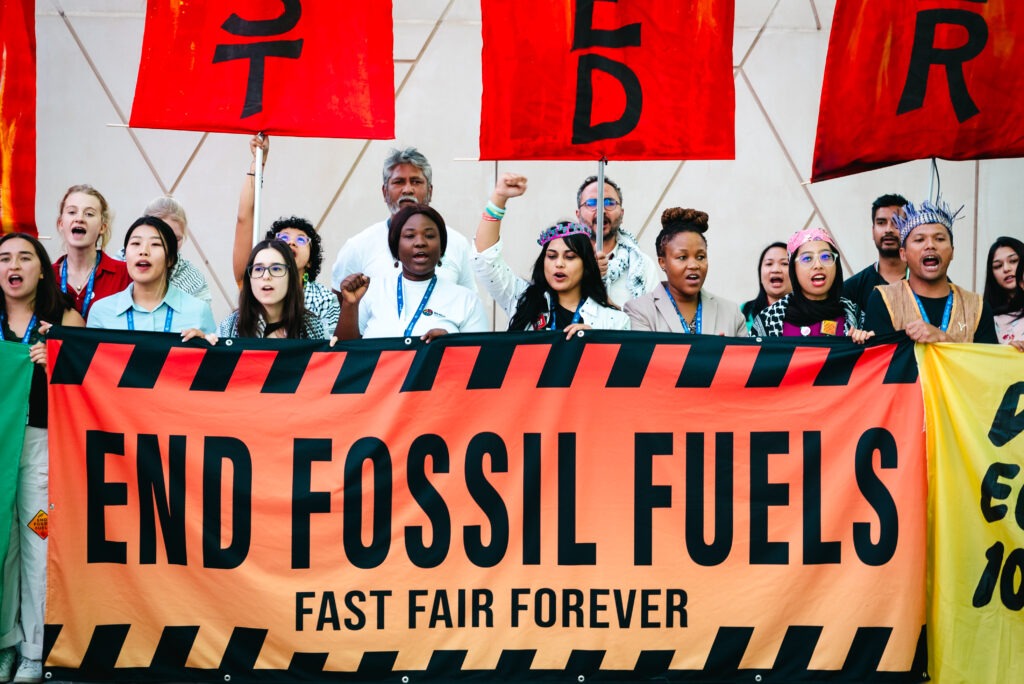
It’s been a week of intense negotiations in Azerbaijan for COP29. Billed as the finance COP, discussions on the New Collective Quantified Goal (a financial target to support developing countries in their climate actions after 2025) are at the heart of what needs to be agreed before this crucial climate summit concludes. These coming days are make or break for all our futures.
The current lack of climate finance is pushing the planet to the brink. Rather than a climate finance goal of $100 billion, as previously agreed, this figure has to be in the trillions now in order to help Global South countries already drowning in debt from climate impacts. This commitment of trillions will also help leapfrog the fossil fuel era by funding the scale up to renewable energy.
The Global South is already paying the cost of floods, droughts, cyclones and destruction caused by climate change. And women are disproportionately impacted. Women and children for example are 14 times more likely than men to die during climate-related disasters, such as floods or cyclones, due to social and cultural barriers.
In order to transition to greener pathways, they need finance from rich countries.
This is not a matter of charity; it’s a matter of justice and righting a fundamental wrong. Rich countries are most responsible for causing climate change but are providing far too little support to countries who are impacted and harmed the most in the Global South.
The estimated fair cost for developed countries is to pay $5 trillion per year in grant-based finance. At COP29 however, the push is to get agreement on $1 trillion per year, way below what is required. The pressure must be kept this week on rich countries to step up and deliver the finance that is urgently needed to give humanity a real chance of averting runaway climate breakdown.
Up to this point, it has been largely civil servants in Azerbaijan, working desperately hard to negotiate how this goal can be achieved. Nothing is resolved in week one, but the gulf in views is laid bare. The result is a sprawling and scrambled negotiations text that covers the good and the bad of climate finance, the scale of the money, the quality, whether through loans and investments or public finance, with questions of who should be on the hook on the table – developed countries or some developing countries too.
It is now in the hands of political leaders who converge this week.
There will be vastly opposing world views, pressure to cave, immense efforts to persuade, all in the backdrop of a tense global political climate.
The backdrop to these talks is the failure to stop war and a plausible genocide in Gaza, and a global rise of the far right with a deadly anti climate action agenda.
All of this is happening as we find ourselves in a general election campaign here in Ireland, with housing and the cost of living dominating the political agenda.
The idea that Ireland plays its part and forks out billions to the Global South in climate finance will seem impossible, with so many homeless and families suffering with high prices of food and essential goods. But we think in the short term at our peril. It is always the poorest who suffer the most, in Ireland and in Bangladesh and in Ethiopia. We must put a better future front and centre in our present.
Every penny spent now to avoid climate disasters later will be the best money we can spend, for Ireland and the world. We need to do this along with reducing our emissions in Ireland and ensuring we do our fair share here. It is not an over statement in any way to say that the future of our planet depends on just climate action.
It is of huge concern that governments from the Global North are emphasising the role of private finance when it comes to climate finance and the new goal. This is being framed that ‘climate injustice’ is essentially an issue of access to private finance on fairer terms. Rather, the injustice is the failure of rich polluting countries to repay the climate debt of the historic responsibilities we owe to the countries on the frontline of the climate crisis.
Yes the private sector has a huge role to play. The shift to renewables will crucially involve private sector innovation in green renewable energy. However, it is a false economy to think that the private sector can be the driver of climate finance.
The countries that are most vulnerable to the climate breakdown are also facing a debt crisis.
ActionAid research found that where data is available, 93% of the countries most vulnerable to the climate crisis are in, or at significant risk of debt distress. The need to service external debt in foreign currency has become a major accelerator of the climate crisis.
There is a vicious cycle between the debt and climate crises, each reinforcing the other. Having more than two thirds of climate finance in the form of loans serves to exacerbate this debt crisis. The real value of these loans is often over-stated and yet, alarmingly, many of the proposals presently considered for expanding climate finance seem to focus on even more loans – rather than exploring fairer and more sustainable alternatives.
The central issue of publicly funded climate finance, not loans, and ending the ever-expanding use of fossil fuels and large-scale agriculture, are among the most important issues the globe needs to focus on.
The experiences of communities in the Niger Delta provides a snapshot of what people in the global south are facing – and a stark reminder of the human cost of fossil fuels.
My colleague, Friday Ogezi, the ActionAid International Climate Justice Advisor for Liberia and Nigeria who is at COP29, said this week that every day more than 2.5 billion cubic feet of natural gas are flared in the Niger Delta, releasing pollutants that have poisoned water sources, destroyed farmland, and sickened people.
A just transition is in all our interests.
We need crucial decisions and action to halt the runaway climate change train, and ensure a safe, just and more equal world for future generations.
He said: “The once vibrant community is now a shadow of its former self. The oil companies have stolen our future. We demand a just transition backed by adequate finance in the form of grants. The time for empty promises is over. It’s time for action.”
Ireland must also play its part and in this election voters should demand this better future of Irish politicians. The Stop Climate Chaos Coalition is hosting a hustings this Wednesday in which representatives of all parties are invited to participate, and outline what their priorities are. Tackling the climate crisis must be at the top of the new government’s agenda. Our future is in their hands.
A fossil free world, built on justice, is the only future.