On World Humanitarian Day, ActionAid Ireland has called for better protection of aid workers who risk their lives daily to serve their communities, especially across war torn Gaza.
ActionAid Ireland CEO, Karol Balfe, said courageous aid workers in Gaza are continuing to provide lifesaving aid every day, despite facing relentless bombardment and the loss of loved ones and colleagues.
Ms Balfe said: “Gaza is the now the world’s deadliest place for aid workers, with OCHA saying the death toll since October 7th stands at a record 287. Human Rights Watch has said humanitarian workers have allegedly been hit by Israeli airstrikes, despite informing the Israeli authorities of their location, while there have been repeated attacks on areas deemed so-called ‘safe zones’ where humanitarian workers are providing urgent care and support to 1.9 million internally displaced Palestinians across Gaza.”
She added: “Many aid workers have lost loved ones themselves yet have continued to support others despite their grief. A staff member at one of ActionAid’s partner organisations recently lost four children in an Israeli military attack, while another lost her husband and brother on the same day.”
Ms Balfe said as global powers gather to discuss a deal that might end this senseless war, aid access in Gaza must be urgently improved so that humanitarian workers can provide lifesaving relief to people in need.
She added: “The only way to end the humanitarian crisis in Gaza is by ensuring the unfettered flow of aid through land crossings into Gaza. This can only be achieved through an immediate and permanent ceasefire.”
Women aid workers in Gaza have described to ActionAid their fears and frustrations as they continue to face extreme danger amid relentless Israeli military attacks and huge logistical challenges in providing humanitarian relief due to aid access restraints.
ActionAid partners in Gaza say the needs of the women and girls they support are increasing while there is a rise in cases of gender-based violence.
Hala, Programme Manager at Alianza por la Solidaridad in Gaza, said: “We are, as women who are working in humanitarian intervention, suffering on more than one level. We have difficulties accessing our offices and our work. We spend [a lot of] time at work and at the office, then [there is the] work we have to handle in our families, to take care of the children and everything in the home.
Nowadays, we cook on the fire, we wash our clothes with our hands…we face many difficulties, and we have to manage them. The third [challenge]…is how you are as a woman, [are handling] the humanitarian work. To be there, to be strong, to be independent, to be able to manage the humanitarian intervention, especially when you have [to] distribute [humanitarian aid] in the community and all the community are struggling to access their needs. So, for me as a humanitarian worker, I’m suffering, [I’m] struggling, but I insist on handling this work; [on managing] the work and [taking care of] my family.’
Buthaina, director of the Wefaq Association for Women and Childcare (WEFAQ), ActionAid’s partner in Gaza, said:
“We face big challenges in our work, especially for us as women, including going out and leaving our homes behind to provide humanitarian aid. In providing these services, we too live in a state of fear and tension. When we leave the house, we entrust our home and our children to God: only God knows if we will be returning to them.
“I will not hide from you that most humanitarian workers, including myself, suffer from anxiety. We can’t sleep; we can’t have sound, uninterrupted sleep. Our sleep is intermittent as a result of the fear we all feel living in the Gaza Strip. Fear haunts us in every step we take to provide humanitarian aid.”
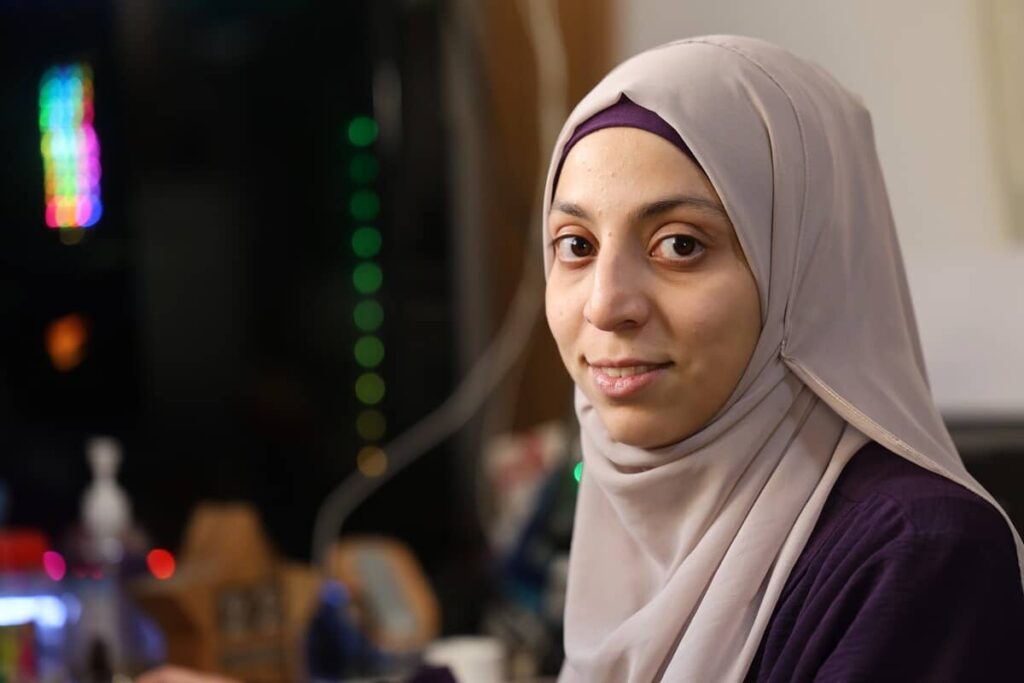
Tasneem, 23, who works with the Palestinian NGO’s Network (PNGO), ActionAid’s partner in Gaza, said supporting others helped her cope with the horrors of the crisis. Having graduated from university just two months before October 7, she recently joined PNGO to work as a part-time translator and media advocate.
She said: “Palestinian or the local NGOs are the first responders for their people, especially in times of emergency. This motivates and inspires me to go and to persist, to keep going and to insist on delivering what I can do for my people with the available resources I have in my hand… Helping my people is a therapy that helps me to heal.”
Aseel works for WEFAQ, which supports people in Gaza and particularly women and girls by providing essentials like food, hygiene products and maternity kits, as well as running a hotline for those experiencing gender-based violence.
She said: “Women [have] faced so many violations, starting from violence due to the Israeli forces and the social violence. Women now became responsible for their families due to losing their husbands or because they are, for example, imprisoned or [have been] killed in this war. Sometimes they are facing some sexual exploitation and to get, for example, a food parcel to feed their children and so on.”
“The chaos of war, limited fuel availability, continuous bombing and unsafe conditions for aid convoys have all slowed down and limited aid deliveries. According to UNOCHA, an average of 169 aid trucks per day made their way across the border in April – a number that has sharply fallen to fewer than 80 trucks in June and July. This comes as Israeli authorities in recent weeks have approved just 24 out of 67 planned aid missions into northern Gaza and around half of those in southern Gaza as famine continues to loom large.”
Gaza is the now world’s deadliest place for aid workers, with the death toll since October 7 standing at a record 287, according to UNOCHA. Israeli airstrikes allegedly hit humanitarian workers despite their having informed the Israeli authorities of their locations, according to Human Rights Watch. Despite repeated attacks on the so-called ‘safe zones’, humanitarian workers are providing urgent care and support to 1.9 million internally displaced Palestinians across Gaza, .
Many aid workers have lost loved ones themselves yet have continued to support others despite their grief: one staff member at one of ActionAid’s partner organisations recently lost four children in an Israeli military attack, while another lost her husband and brother on the same day.
Fatma, a project officer with ActionAid-Alianza, said: “We’re suffering from many challenges that make delivering services for the targeted group more difficult. Some of these challenges are the random shelling and bombing everywhere…there is no safe place for the targeted group to [access] the service…Also, the continuous displacement and evacuation from place to place for the people… [makes delivery] and access to the service more difficult.”
Yet despite the challenges, humanitarian workers in Gaza have proven remarkably resilient and able to adapt quickly and effectively as circumstances change, remaining unwaveringly dedicated to supporting those in need. Women humanitarian workers have built trust and reached the women and girls who most require support, ensuring to meet their needs.
Samira lives in the Al-Istiqama camp for displaced people in Deir al-Balah, which she herself helped set up and now helps manage, supporting the women and girls who are among the almost 2,000 people sheltering there and who – thanks to her efforts – have access to a medical point, education point, entertainment point and psychological support.
She said: “I am proud of myself because I was able to manage things more than any young man. I can enter any tent and see what people need and see what women need…and [what] girls need…We want things to support women because women [suffer] a lot.”
For more information, here.