ActionAid Ireland says Gaza residents are too malnourished to donate blood amid soaring hospital demand and widespread disease

ActionAid Ireland has said a hospital in northern Gaza is having to turn away potential blood donors, despite a huge demand for blood supplies to help the sick and injured, because volunteers are so weakened from malnutrition. Despite facing appalling personal circumstances, many people selflessly responded to Al-Awda Hospital’s call-out for blood donations, but with the whole of Gaza at high risk of famine, many were deemed too unwell to undergo the process. 

Dr Mohammed Salha, acting director of Al Awda Hospital, which is run by ActionAid’s partner Al-Awda, said: “Frankly, there is a shortage in the quantities and units of blood that are being [donated] because people are suffering from malnutrition, specifically in the northern Gaza Strip.”

He added: “Blood tests are carried out on people who come to donate and there is a large percentage of [people who come to donate blood] who are [already] suffering from malnutrition, so blood units are not drawn from them to use as donations for the wounded and sick. Frankly, malnutrition is widespread, specifically in the northern Gaza Strip. For over five months, no vegetables, fruit, or meat have been brought into the northern Gaza Strip.” 

The hospital – which is one of just 16 that is partially functioning across Gaza – is also seeing many cases of people with infections and diseases because of the catastrophic and inhumane conditions people are being forced to live in.

Dr Salha said: “In addition to the spread of many skin diseases… there are thousands of [people who] have come to the hospital here and the hospitals operating in the northern Gaza Strip [who are] suffering from viral hepatitis.” 

A toxic combination of intense overcrowding, a lack of water and hygiene products, and the accumulation of waste and sewage in the streets is creating the ideal conditions for diseases to thrive.

Evacuation orders currently cover 86% of Gaza, according to UNRWA, forcing most of the population to cram into an area measuring less than one -sixth of the strip, where they live shoulder to shoulder and illnesses are rapidly spreading.  

ActionAid Ireland CEO, Karol Balfe said: “It’s no surprise at all that diseases and infections are running rampant in Gaza when people have been forced to live in such appalling and dehumanising conditions, and have barely anything to eat. It’s truly admirable that despite these dreadful circumstances people are still wanting to help one another and support hospital staff by donating blood – even if, devastatingly, they are far too sick themselves to be able to do so.”

Ms Balfe said that ActionAid staff and partners are doing everything in their power to help, including by providing fresh food, hot meals and hygiene kits to people in need, but they face enormous challenges. Currently, 19 trucks carrying ActionAid hygiene and dignity kits are currently stuck in Egypt, waiting to be allowed to cross into Gaza, where demand for them is huge.

She added: “It is imperative that aid access both into and within Gaza is rapidly improved, so that our dedicated colleagues can help more people. Above all, as the horrific death toll from this crisis approaches 40,000, there must be a permanent ceasefire now, before any more people die from Israeli military attacks, starvation or disease.”  

The most recent data from the WHO shows a rise in acute respiratory infections, acute watery diarrhoea, acute bloody diarrhoea and jaundice across Gaza, as well as tens of thousands of cases of scabies, lice and skin rashes.

UNRWA said between 800 and 1,000 new cases of hepatitis are being reported at its health centres and shelters across Gaza per week. Alarmingly, six strains of poliovirus have been detected in environmental samples in Gaza, including in sewage flowing between displaced people’s tents, according to Gaza’s Health Ministry. The WHO is warning there is a high risk the highly infectious viral disease could spread, posing a particular risk to unvaccinated children under the age of five.  

The spread of diseases is exacerbated by the fact that people have hardly any water to keep themselves clean, with less than five litres available on average per person for all their needs per day due to the extensive destruction of water facilities from Israeli military attacks. Oxfam said attacks had destroyed or damaged an average of five water and sanitation infrastructure sites every three days since the crisis began – and, just last week, the Israeli soldiers reportedly bombed the main source of drinking water in Rafah, the Tal Sultan Water Reservoir.

People in Gaza also have little or no access to soap and other vital hygiene products. Arwa*, who is displaced with her young children in Gaza, told ActionAid: “I have little ones who are starting to get lice. There is no shampoo or anything to use to wash the children… A rash has appeared on my children, as well as lice and headlice. We need personal care items so we can keep our children clean. We need authorities to provide us with aid. We need clean water…We demand an end to the war so that we can return to our homes and to the clean conditions that we had.” 

At the same time, hazardous waste and sewage is accumulating in the streets and around people’s tents. More than 140 temporary dumping sites have appeared as a result of Gaza’s two major landfill sites being inaccessible. In a recent assessment, UNDP said Gaza’s solid waste management had totally collapsed, resulting in serious public health consequences including a spike in cases of diarrhoea and acute respiratory infections.  

For more, read here.
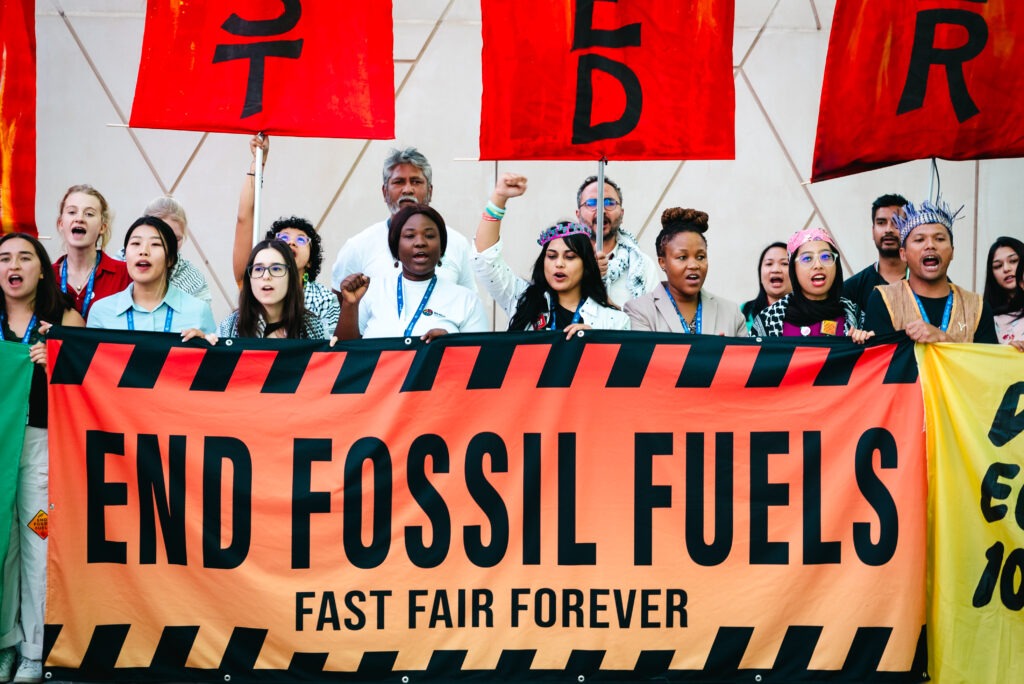
Protesters holding End Fossil Fuels banner at a climate demonstration, advocating for renewable energy solutions.

Protestors at COP 28 in Dubai. Photo: Konrad Skotnicki.

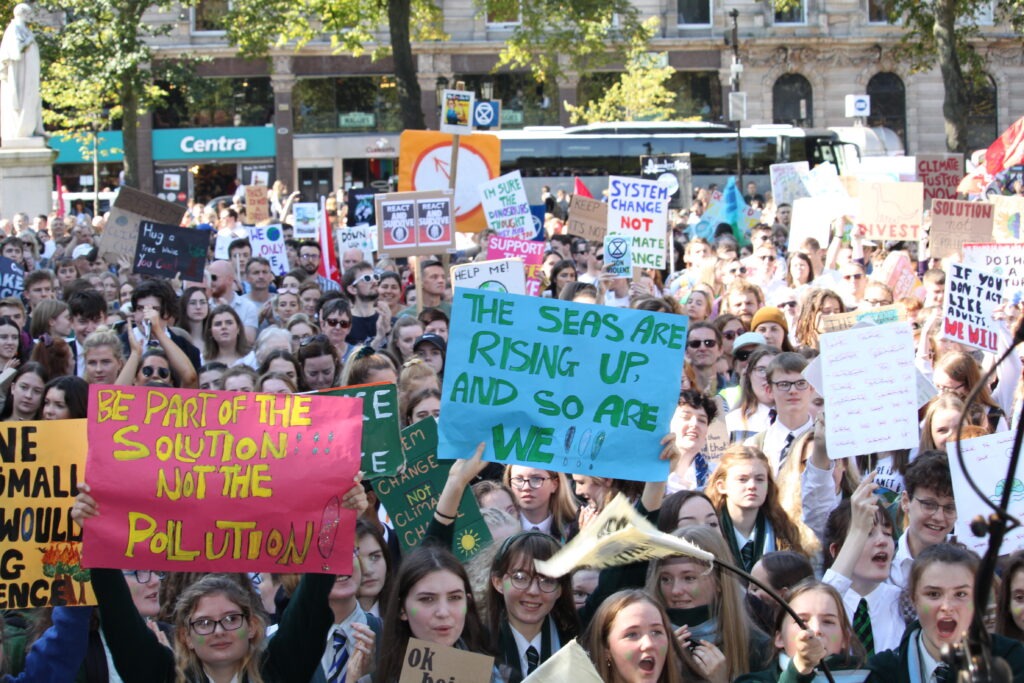
Climate protest with diverse crowd holding signs about environmental action in a city square.

Belfast Climate Change March, 2019. Photo: Trócaire.

The Profit Driving the Crisis

Despite their overwhelming contribution to global emissions, fossil fuel companies continue to attract significant financial backing—driven by their enduring profitability. This is starkly illustrated by the case of ExxonMobil, the top fossil fuel investment held by asset managers based in Ireland. In 2023, ExxonMobil reported €33.63 billion ($36 billion) in profit. That is almost twice the GDP of Botswana (€18.1 billion) and nearly three times Namibia’s GDP (€11.5 billion).

Ireland plays a hugely disproportionate role in facilitating investments into fossil fuel companies like ExxonMobil. In 2023, the investments made into fossil fuel companies by investment managers based in Ireland generated an estimated 72.5 million tons of CO2e. This is more than the CO2e emissions for the entire country of Ireland—and more than ten times that generated by Sierra Leone.

The Global Human Impact

The climate crisis is here, now, and it is causing disproportionate harm in the Global South. In Bangladesh, rising sea levels and increasingly severe cyclones are displacing coastal communities, with projections indicating that 17% of the entire country could be underwater by 2050. The legally binding Paris Agreement on climate change explicitly acknowledges the importance of tackling private finance. Its three overarching goals are: keeping below 1.5C of warming; increasing adaptation and making finance flows consistent with low emissions and resilience.

This gives a clear mandate for action:  both tax reform and corporate regulation are needed to tackle financial flows, and both nationally in Ireland and at EU level, ‘polluter pays’ taxes are lacking and regulation of the financial sector remains weak and fragmented. While EU regulation exists, it is designed more to nudge investors toward more sustainable investment practices by increasing transparency and reporting levels than to enforce strict standards. And it is moving in the wrong direction: the recently passed EU Corporate Sustainability Due Diligence Directive excluded investments; and now the EU Commission’s Omnibus legislative proposal threatens to undo the limited gains made on climate plans, as well as blocking future attempts for stronger action at national level.

The Risk of Inaction

Fossil fuel investment is too profitable to remain weakly regulated. If Ireland continues with its current strategy of encouraging FDI at all costs, and relying on weak EU regulation, we are headed for catastrophe. The Inter-governmental Panel on Climate Change has repeatedly warned that every fraction of a degree beyond 1.5°C brings irreversible consequences: collapsed ice sheets, vanishing coral reefs, and extreme weather events that will make vast regions of the planet uninhabitable. And yet, companies are developing oil and gas fields that could push global warming beyond 2°C.

Our research found that 91% of the investments made into fossil fuel companies by investment managers based in Ireland were to companies that have plans for fossil fuel expansion like these. Ireland cannot afford inaction on this issue.

About This Research

The figures in this report regarding investment from Ireland are based on new research commissioned by ActionAid Ireland and Trócaire. In the paper, we uncover the scale of fossil fuel investment through Ireland, who the investors are, and in which fossil fuel companies they are investing.  We analyse the current regulatory framework and explain why it is inadequate—and moving in the wrong direction. And we make specific recommendations for change, which are summarised below.

Summary of Recommendations

Regulate the private financial sector
Ireland must end its outsized role as an enabler of destructive fossil fuel investment. Ireland should introduce a strong gender-responsive national human rights and environmental due diligence framework which includes the regulation of investors with respect to human rights and the environment and climate. The transposition of the EU Corporate Sustainability Due Diligence Directive could achieve this if downstream activities are included and the Omnibus proposal is rejected. Ireland should prohibit investments in fossil fuel expansion and require investors to implement climate transition plans consistent with a 1.5°C climate limit.

Endorse the Fossil Fuel Non-Proliferation Treaty
Ireland should endorse developing a Fossil Fuel Non-Proliferation Treaty to curb fossil fuel expansion and commit to a fair and funded phase out of fossil fuels.

Support tax justice
Ireland should support bold and fair new global tax rules through the UN Framework Convention on Tax, should adopt all OECD BEPS measures, and should conduct an updated and comprehensive spillover analysis of its tax policy. Ireland should take coordinated action globally, at the EU level and domestically to introduce a range of new taxes to mobilise finance needed for climate justice, based on ‘polluter pays’ and social equity principles such as wealth taxes for the highest earners, climate damages tax on investors, fossil fuel production taxes and levies on aviation and shipping.

Finance a just transition
Ireland must also meet its fair share climate finance obligations under Article 9.1 of the Paris Agreement, and pay our ecological debt to the Global South. Ireland should support conditionality-free debt cancellation for countries on the front lines of the climate crisis, commit to a new UN Framework Convention on Sovereign Debt, moving debt negotiations from the IMF to the UN, and to a debt workout mechanism that is fully representative and fair.

Further reading