Pearse’s great-grand-nephew on 1916

Why the values of Ireland’s 1916 Easter Rising inspire people around the world today, and why they are so needed

By Padraig Pearse’s great grand-nephew Ben Phillips (an Englishman)

This Easter, people across Ireland are proudly commemorating 100 years since Padraig Pearse and his comrades led the Rising against British Imperial rule. The rebels were not universally welcomed in 1916. They saw that in the struggle for justice you cannot wait till everyone is ready, and that to endure defeat is part of eventual victory. Time proved them right and confirmed their place, and the relatives of the rebels are being welcomed to a series of events by the President and Taoiseach.

I’m attending on behalf of Padraig Pearse’s family. And I am English. It is a great tribute to the values of the freedom movement that I have never met an Irish person for whom this matters. This is partly because Ireland is a nation of emigrants, its sons and daughters spread across the globe, from Canada to New Zealand and everywhere in between, and so the Irish sense of national family is broader. But it is also because the values that drove the Rising transcend both nationality and time.

Earlier this month I attended the beautiful St Patrick’s Day celebrations hosted by Ireland’s Ambassador to Kenya, where I now live and work for the international NGO ActionAid. The Ambassador spoke some very moving words about Pearse, and so I found myself in a series of wonderful conversations about the Rising. Listening to Irish expatriate NGO workers, diplomats, business people, as well to the most inspiring Irish nuns who work in Nairobi’s toughest slums, I was struck by how the values of Ireland’s rebels still inspire such a broad swathe of Irish people today.

But I was also struck at the event at how Ireland’s Rising resonated with Kenyans – they too had had been denied their land and their culture, they too had had to win their freedom; indeed, it can be said that Ireland’s freedom movement was the first to show that a people colonized by Britain could defeat the colonizers. But what struck me most from all the conversations was that what inspired people about the Rising was not a narrow nationalism but a love of justice, with people moved by a 100 year old call for “equal rights and equal opportunities of all, cherishing all children equally”.

(For the Rising to inspire beyond one country is not new. Indeed, we know from the history that even the British officer who chaired Pearse’s court martial could see the justness of cause, commenting “I have just done one of the hardest tasks I have ever had to do. I have had to condemn to death one of the finest characters I have ever come across. There must be something very wrong in the state of things that makes a man like that a rebel.”)

The idealist poet Pearse, the workers’ leader James Connolly and the pioneering feminist Constance Markievicz did not struggle only to replace English rulers with Irish ones but to replace landgrabbing by the rich with fair land redistribution to the poor, cramped slums with room to move, painful hunger with full stomachs, squalor with dignity, exploitation with decent work, corporate impunity with workers’ rights, inequality with equality, hopelessness with hope, shame with self-worth. They saw that the struggles for political democracy, economic justice and cultural self-confidence were interconnected and inseparable. Across the world, those lessons could not be more necessary today. It’s a privilege that my job as Campaigns and Policy Director with ActionAid enables me to support communities campaigning against injustice, and working for more equal societies.

So how come I came to be English and a Pearse? Padraig’s youngest sister Mary-Kate (by birth his cousin, taken into the family when she was orphaned), was the only one of their household to have children. She is my great-grandmother. On a holiday at the Royal Hotel in Galway, Mary-Kate complained to the management about another guest who left the communal bathroom in a mess. The management made the errant guest apologise to her in person. He was Sydney Shovelton. He was English. She liked him. She married him.

She passed onto her Irish-English children the stories of her adored brother, and her pride in the values he lived by. And each generation passed on the same. Along with so many people across Ireland and across the world, I still feel moved by his call to dream for a more just world and to work to make that dream a reality: “The wise have pitied the fool that hath striven to give a life/ …To dream that was dreamed in the heart, and that only the heart could hold./ Oh wise men, riddle me this: What if the dream come true?”

Ben Phillips is Padraig Pearse’s great grand-nephew. He lives in Nairobi where he is is International Director of Policy, Research, Advocacy and Campaigns for ActionAid, an NGO working to tackle inequality and injustice. He has lived and worked in four continents and 11 cities. Ben is on twitter at @benphillips76
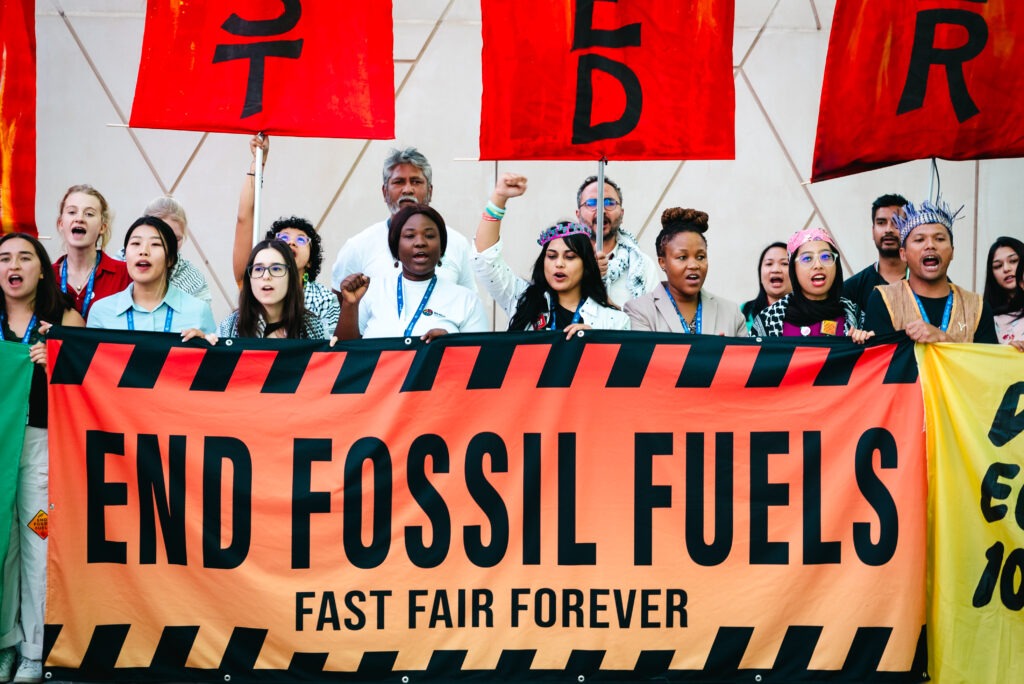
 

Protesters holding End Fossil Fuels banner at a climate demonstration, advocating for renewable energy solutions.

Protestors at COP 28 in Dubai. Photo: Konrad Skotnicki.

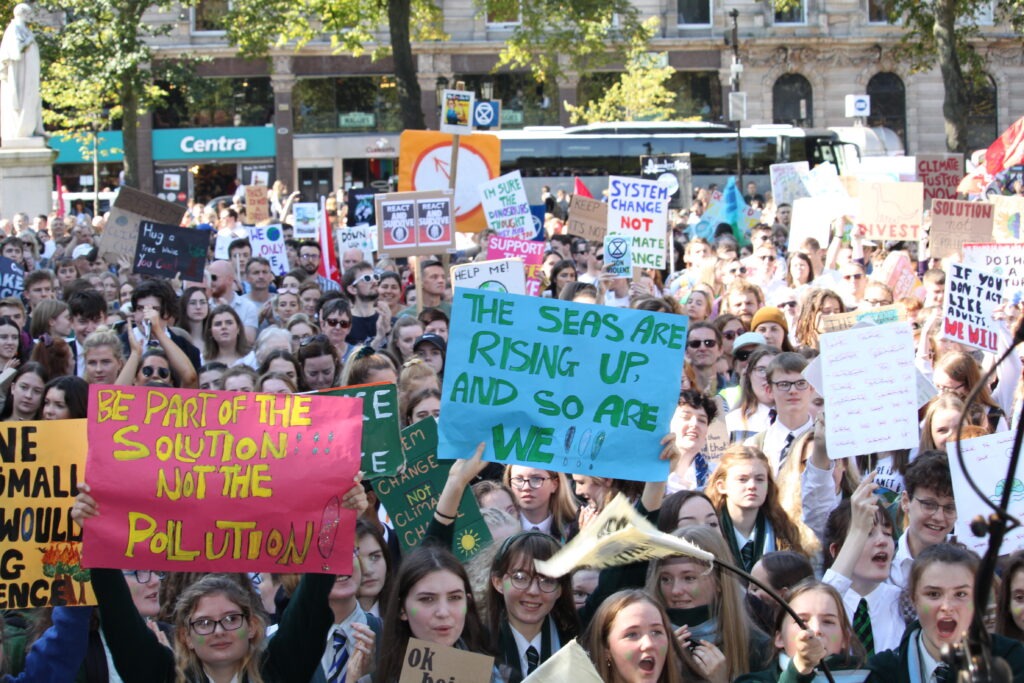
Climate protest with diverse crowd holding signs about environmental action in a city square.

Belfast Climate Change March, 2019. Photo: Trócaire.

The Profit Driving the Crisis

Despite their overwhelming contribution to global emissions, fossil fuel companies continue to attract significant financial backing—driven by their enduring profitability. This is starkly illustrated by the case of ExxonMobil, the top fossil fuel investment held by asset managers based in Ireland. In 2023, ExxonMobil reported €33.63 billion ($36 billion) in profit. That is almost twice the GDP of Botswana (€18.1 billion) and nearly three times Namibia’s GDP (€11.5 billion).

Ireland plays a hugely disproportionate role in facilitating investments into fossil fuel companies like ExxonMobil. In 2023, the investments made into fossil fuel companies by investment managers based in Ireland generated an estimated 72.5 million tons of CO2e. This is more than the CO2e emissions for the entire country of Ireland—and more than ten times that generated by Sierra Leone.

The Global Human Impact

The climate crisis is here, now, and it is causing disproportionate harm in the Global South. In Bangladesh, rising sea levels and increasingly severe cyclones are displacing coastal communities, with projections indicating that 17% of the entire country could be underwater by 2050. The legally binding Paris Agreement on climate change explicitly acknowledges the importance of tackling private finance. Its three overarching goals are: keeping below 1.5C of warming; increasing adaptation and making finance flows consistent with low emissions and resilience.

This gives a clear mandate for action:  both tax reform and corporate regulation are needed to tackle financial flows, and both nationally in Ireland and at EU level, ‘polluter pays’ taxes are lacking and regulation of the financial sector remains weak and fragmented. While EU regulation exists, it is designed more to nudge investors toward more sustainable investment practices by increasing transparency and reporting levels than to enforce strict standards. And it is moving in the wrong direction: the recently passed EU Corporate Sustainability Due Diligence Directive excluded investments; and now the EU Commission’s Omnibus legislative proposal threatens to undo the limited gains made on climate plans, as well as blocking future attempts for stronger action at national level.

The Risk of Inaction

Fossil fuel investment is too profitable to remain weakly regulated. If Ireland continues with its current strategy of encouraging FDI at all costs, and relying on weak EU regulation, we are headed for catastrophe. The Inter-governmental Panel on Climate Change has repeatedly warned that every fraction of a degree beyond 1.5°C brings irreversible consequences: collapsed ice sheets, vanishing coral reefs, and extreme weather events that will make vast regions of the planet uninhabitable. And yet, companies are developing oil and gas fields that could push global warming beyond 2°C.

Our research found that 91% of the investments made into fossil fuel companies by investment managers based in Ireland were to companies that have plans for fossil fuel expansion like these. Ireland cannot afford inaction on this issue.

About This Research

The figures in this report regarding investment from Ireland are based on new research commissioned by ActionAid Ireland and Trócaire. In the paper, we uncover the scale of fossil fuel investment through Ireland, who the investors are, and in which fossil fuel companies they are investing.  We analyse the current regulatory framework and explain why it is inadequate—and moving in the wrong direction. And we make specific recommendations for change, which are summarised below.

Summary of Recommendations

Regulate the private financial sector
Ireland must end its outsized role as an enabler of destructive fossil fuel investment. Ireland should introduce a strong gender-responsive national human rights and environmental due diligence framework which includes the regulation of investors with respect to human rights and the environment and climate. The transposition of the EU Corporate Sustainability Due Diligence Directive could achieve this if downstream activities are included and the Omnibus proposal is rejected. Ireland should prohibit investments in fossil fuel expansion and require investors to implement climate transition plans consistent with a 1.5°C climate limit.

Endorse the Fossil Fuel Non-Proliferation Treaty
Ireland should endorse developing a Fossil Fuel Non-Proliferation Treaty to curb fossil fuel expansion and commit to a fair and funded phase out of fossil fuels.

Support tax justice
Ireland should support bold and fair new global tax rules through the UN Framework Convention on Tax, should adopt all OECD BEPS measures, and should conduct an updated and comprehensive spillover analysis of its tax policy. Ireland should take coordinated action globally, at the EU level and domestically to introduce a range of new taxes to mobilise finance needed for climate justice, based on ‘polluter pays’ and social equity principles such as wealth taxes for the highest earners, climate damages tax on investors, fossil fuel production taxes and levies on aviation and shipping.

Finance a just transition
Ireland must also meet its fair share climate finance obligations under Article 9.1 of the Paris Agreement, and pay our ecological debt to the Global South. Ireland should support conditionality-free debt cancellation for countries on the front lines of the climate crisis, commit to a new UN Framework Convention on Sovereign Debt, moving debt negotiations from the IMF to the UN, and to a debt workout mechanism that is fully representative and fair.

Further reading